
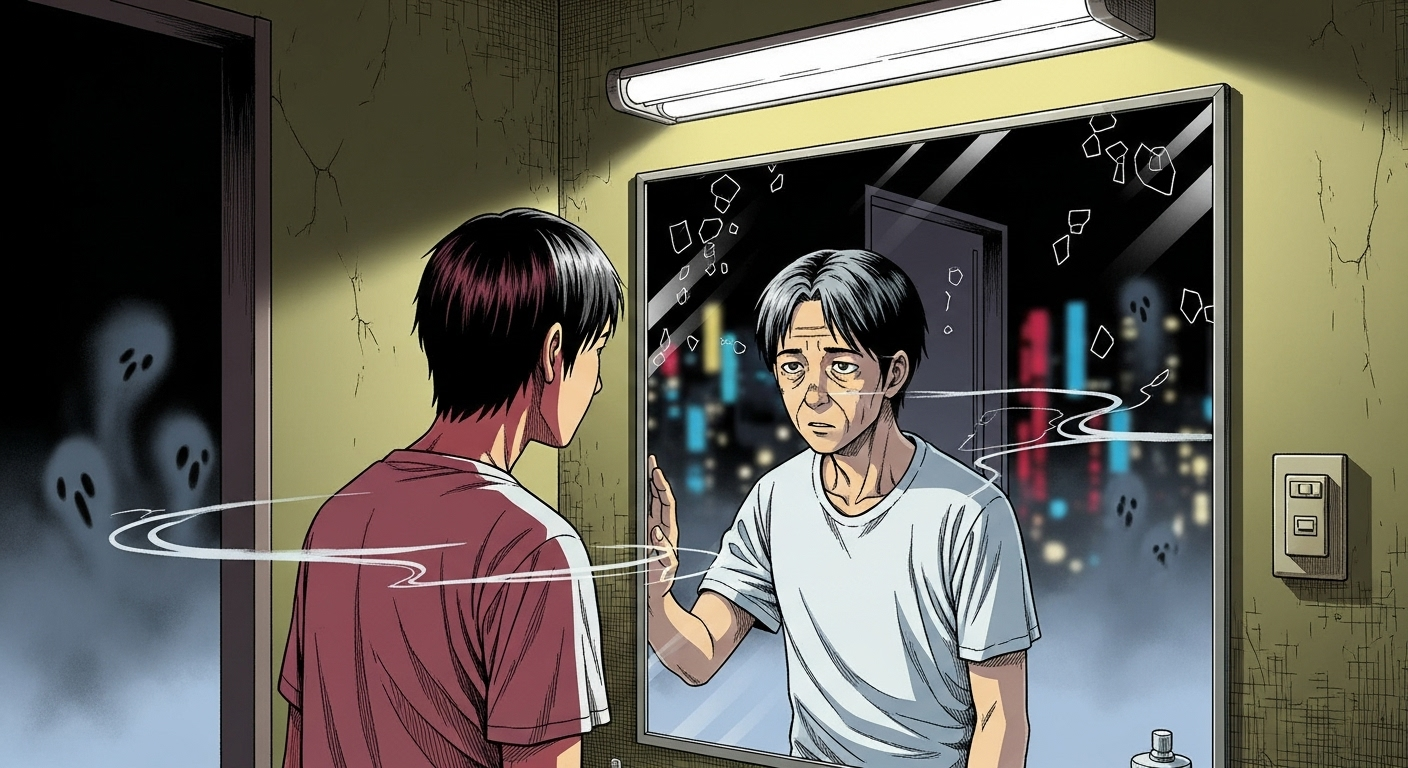
The first time Haruto noticed it, he was brushing his teeth in the bathroom of his small Tokyo apartment.
He caught his reflection out of the corner of his eye and froze. The face staring back at him was the same as always — pale, tense, twenty-two years old. But the eyes… the eyes seemed older. Tired. Framed with faint shadows he didn’t feel in his own skin.
He blinked. Nothing changed. He leaned closer. The subtle creases beneath the eyes were real. Wrinkles curling just slightly, like someone had been carved into the glass without permission.
Haruto shook his head. “I’m imagining things,” he muttered.
But the reflection didn’t blink when he did.
For days, he avoided mirrors. Not out of fear, exactly — he just didn’t want to see it happen again. The kitchen tiles reflected him slightly, the metal of the refrigerator glinting in the morning sun. Every reflection hinted at the same impossible thing: he was still young, but his mirrored self aged with quiet inevitability.
He started covering the mirrors with towels, plates, whatever he could find. Even the microwave door, the glass of his windows — he didn’t want to see it.
And yet, he couldn’t help glancing.
The city outside carried on as usual.
Neon signs buzzed faintly at night. Rain fell in thin, silver lines. Haruto walked past vending machines on the corner, feeling the ordinary pulse of Tokyo — the hum of traffic, the clink of coins, the faint smell of wet asphalt. Everything was normal. But inside, the apartment felt heavier.
The first night he dared to sleep, he dreamed of mirrors. Endless corridors lined with glass, each reflection a little older than the last. Some smiled too widely, some frowned. He couldn’t tell which was real, which was his own self, or if any of them mattered at all.
When he woke, the bathroom mirror had a faint crack across the corner. He hadn’t dropped anything.
He tried rational explanations.
Stress. Long hours at the part-time job. Lack of sleep. The constant hum of the city filtering through his window.
But rational thoughts didn’t change the reflection’s age.
It kept getting older.
By the end of the week, he noticed faint graying along the temples of his mirrored hair. By the second week, his own hair remained the same, soft and black, while the reflection’s skin sagged slightly, eyes darkened beneath the weight of imagined decades.
He stopped brushing his hair in front of mirrors altogether. Stopped checking his phone in reflective surfaces. Stopped looking at windows at night.
One evening, he returned from a long shift, drenched in rain. The apartment smelled faintly of damp and detergent. He paused in the hallway.
The reflection in the glass panel of the shoe cabinet caught his eye.
His older self leaned casually against the cabinet’s frame, watching him with a patience he didn’t feel in his own bones.
Haruto stepped back. The reflection did not move. It only smiled faintly, a knowing, sorrowful smile.
He whispered, “Who are you?”
The reflection did not answer. It could not. And yet, he felt a response deep inside him, a silent certainty that someone — or something — had always been waiting in that glass.
Sleep became impossible.
He would lie awake on the narrow futon, listening to the city hum, watching the faint neon from outside slide across his ceiling. Every flicker of light, every shadow along the walls, seemed to deepen the lines of his reflected self.
He tried talking to it. “Stop aging,” he muttered. “I don’t understand you. Why are you here?”
No answer came. Only the reflection staring back, older, quieter, still.
By the third week, he stopped leaving his apartment. He stopped ordering food. He barely moved. The city beyond the glass became a muted blur, a background hum he no longer registered.
The reflection, however, remained, patient and eternal.
Haruto began to notice subtle differences beyond age.
The reflection’s eyes seemed to carry memories he didn’t recognize. Small, private gestures — a twitch of the lips, the tilt of a head — that never belonged to him.
One morning, he washed his hands in the sink and caught the reflection rubbing its own eyes, as if it had been crying. But he hadn’t cried. Not in days.
He stumbled back, gripping the edge of the counter. “Stop. Please.”
But the reflection smiled, faintly, as though humoring a child’s wish.
Weeks passed.
Haruto stopped talking to friends. He stopped answering calls. He stopped looking outside. The world narrowed to a single corridor of mirrors — bathroom, kitchen, window glass — all silently marking the passage of time he could not see in himself.
He began speaking aloud to the reflection, though he knew it could not answer. “You’re not real. You’re just… just a trick.”
The reflection tilted its head. Older. Smiling faintly. “Am I?” he imagined it saying.
He shivered. He could hear the whisper of its voice in the back of his mind, a suggestion rather than speech: We are real together. You just refuse to see it.
He tried to break the mirrors.
The first time, he swung a broom at the bathroom mirror. The bristles struck glass, which cracked faintly, but the reflection did not shatter. It only shifted slightly, the lines on its face deepening, as though amused.
He dropped the broom. His hands shook. He couldn’t understand. He had always been able to break things. Why not this?
He tried again. Every mirror in the apartment bore scratches, dents, shards — yet the reflected self remained whole, whole and older, patient and watching.
Haruto stopped sleeping altogether.
He would sit in the dark apartment for hours, staring at the reflections, tracing the folds of age on his face. His own body stayed the same. His bones, his skin, his hair — unchanged. But the reflection aged, and with every tick of the clock, it seemed closer, somehow, reaching toward him across an invisible divide.
One night, he dared to whisper, “What do you want from me?”
The reflection’s lips moved, perfectly synchronized, though the words were silent in the air.
He imagined it saying: I want you to see.
And suddenly, he understood.
It was not malevolent. Not cruel. Not even conscious.
It was inevitability. A mirror of what he could not escape. The reflection carried decades he would never live, sorrow and joy, time that was still ticking in some strange parallel.
Haruto’s stomach turned. He had been staring at himself, expecting an answer, expecting life to explain itself — when life itself had been moving on without him.
The reflection was older because time had not forgotten him. He had forgotten it.
Days blurred together.
He began to accept the reflection. He no longer hid. He no longer tried to break it. He would stand for hours before the bathroom mirror, tracing the lines of age in the glass.
Sometimes he spoke. “I see you.”
The reflection tilted its head. Older. Calm. Almost smiling.
“I’m still me,” Haruto whispered.
You always were, the reflection seemed to answer, in the small tremor of memory running through his chest.
And he believed it, partially.
Yet a melancholy settled deep in his bones.
The world outside his window continued its rhythm: the clatter of trains, the neon buzz, rain running down asphalt streets. But inside, in the apartment, time had folded into a single thread between him and the glass.
He ate when he could. He moved when he must. But he no longer felt the same spark of youth. The reflection reminded him every day: there is a future he would never see. There are years written on the glass that would never touch his body, decades he would never walk through.
He began speaking softly to it, sharing little details of his life. “I bought milk today. The vending machine ran out of chocolate milk.”
The reflection aged another week in silence.
And he felt something small, terrible: envy. Not of life itself, but of the self that carried it — the self that would keep moving through years while he stayed young, trapped in a single age.
Haruto tried to sleep again, lying on the futon beneath the faint hum of fluorescent lights.
The reflection leaned closer in the glass, eyes weary, full of decades he could never claim. He felt its silent gaze pressing into him, a gentle accusation: Why do you fear me?
He whispered, “I’m afraid of forgetting.”
The reflection’s faint smile deepened. It seemed to sigh. He imagined it saying: You will remember me. Always.
And for the first time, he wept. Not for himself. Not entirely. But for the years he would never hold, the age he would never carry, the slow inevitability he could see but never feel.
Weeks passed like this.
Haruto no longer covered mirrors. He no longer looked away. He would stand, quiet and small, before the aging self he could not be. And in that quiet, he began to understand that life was not measured in the years he could live, but in the moments he could see reflected, even if they were beyond him.
Some nights, he thought he saw faint movement in the reflection — the hair shifting, the eyes twitching, a deeper laugh or a tremor of lips. But when he blinked, it was still. Silent. Waiting. Patient.
One morning, he woke to find the reflection older than he remembered. The eyes had deeper lines, the hair showing subtle silver strands. And yet, his own body had not changed. Twenty-two years old, soft black hair, unlined skin.
He stared. And in that stare, he realized: he would never age, but he would always witness aging. He would live in the present while the reflection carried all the years he could not.
A soft melancholy filled him — profound, quiet, infinite.
He whispered to the reflection: “I suppose we are both alive, then. In our own way.”
The reflection’s eyes seemed to glimmer faintly. A silent nod. A subtle acknowledgement that their lives were forever entwined, separate yet bound by glass and time.
Haruto turned away finally, sat on the futon, and let the city hum outside fill the apartment with ordinary sound. He did not move to cover the mirror. He did not look away. He simply let it be, a presence, a reminder, a melancholy companion.
And every morning, when he wakes, the reflection smiles a little more, carrying all the years he will never live — and he knows he will never stop watching it.