
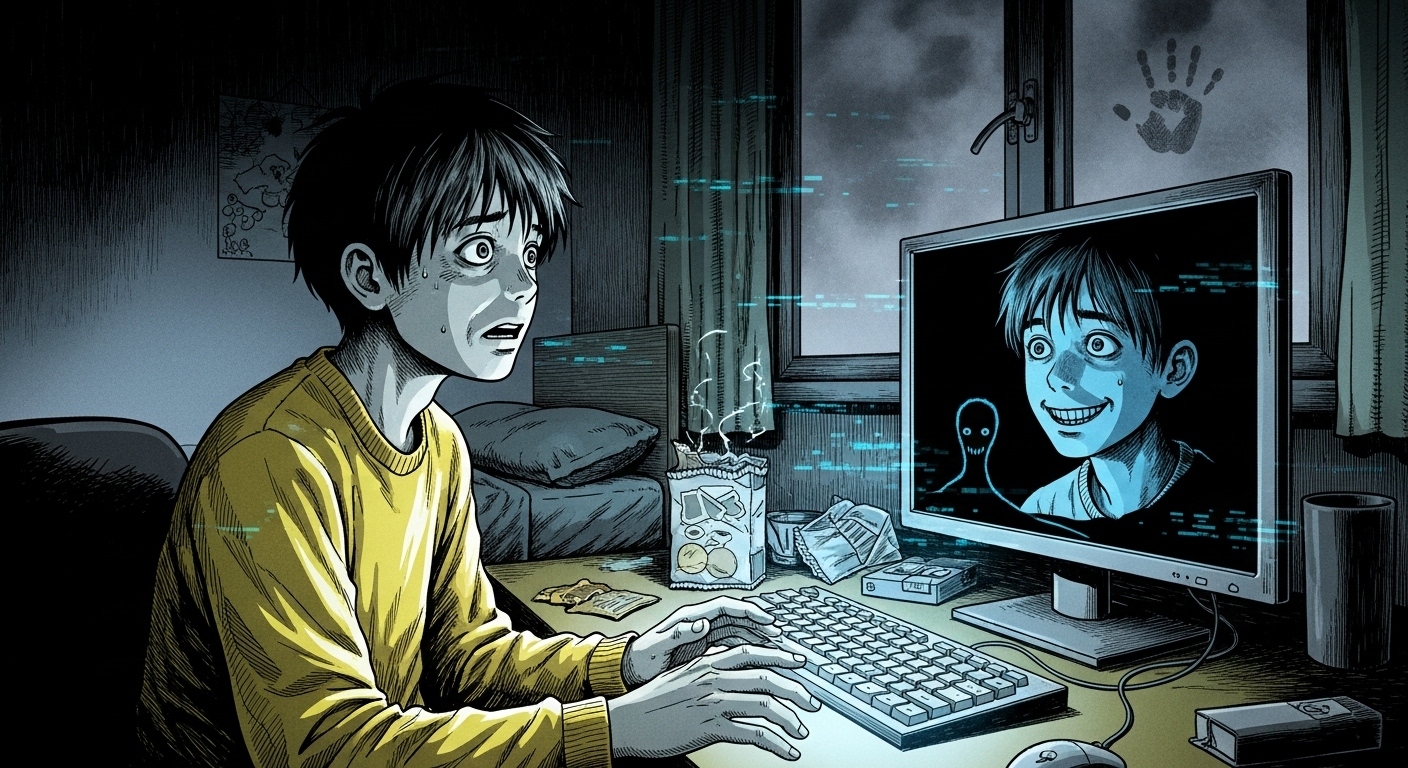
I saw my reflection in the monitor long after the screen went dark.
For a second, Luka thought it was just lag. He’d been gaming for six hours straight, lights off, blinds drawn, the pale glow of the monitor painting his face ghost-white. His room smelled faintly of pizza crusts and the dust that gathers behind old computer fans. But that wasn’t what made his stomach twist. It was the reflection staring back at him from the black screen—smiling.
He wasn’t smiling.
The smile was slow and deliberate, as if whoever wore his face knew something he didn’t. Luka blinked, leaned closer, and the reflection copied the motion half a second too late. A chill crawled up his neck.
“Very funny,” he muttered, forcing a laugh. Maybe his webcam was on. Maybe someone had hacked him.
He moved the mouse. The screen came to life, bright and normal, the familiar landscape of his favorite game glowing in front of him. He exhaled. His reflection was gone.
Outside, the November rain scraped softly against the window. Somewhere in the house, the boiler clicked and sighed. Luka adjusted his headset, brushed the unease off, and loaded into another match.
This time, something was off in the game.
The loading screen flickered, showing strange fragments—his bedroom wall, his desk lamp, even his own face—flashed for an instant between scenes of the game’s forest. It was like the game was using his webcam feed as part of the world. Luka frowned, shaking his mouse. “Okay, that’s not normal.”
Then came the voice.
“You shouldn’t play after midnight.”
It was faint, female, a whisper that slithered through his headphones.
Luka froze. The voice hadn’t come from his friends’ chat. He checked—empty lobby. He was alone. His throat went dry. “Who’s there?” he whispered.
Static hissed in response. Then, almost too soft to catch, the same voice said, “You shouldn’t play here.”
The game loaded. The usual forest was darker, denser. The trees seemed to move when he wasn’t looking. He started walking his character forward. The wind in the game howled, but beneath it came another sound—a knock.
It wasn’t from the game.
It came from his window.
Knock. Knock. Knock.
Luka’s heart thudded against his ribs. He turned his chair, expecting rain hitting the glass. But there was something else—a handprint. Pale. Human-sized. It smeared down the window, leaving streaks that looked almost… deliberate.
His phone buzzed. A message popped up from his best friend, Erik: Still gaming? You seeing weird stuff in the forest level?
Luka typed back fast. Yeah. What is this? Some update?
Not me, Erik wrote. My avatar froze. Someone’s walking around with my name.
The chill deepened. Luka spun back to his monitor. In the game, his character stood before a cabin. A second avatar moved behind him—Erik’s username floating above it—but the movements were wrong. Too jerky. Too human.
“Erik?” Luka whispered.
The avatar turned its head. Slowly. Way too slowly.
Its face was blank white.
Luka ripped off his headset. His pulse was pounding so hard it hurt. He reached to shut the PC down, but the mouse froze. The cursor began moving on its own, dragging across the screen, opening a file that didn’t exist before.
“No way,” he breathed. “No way.”
He yanked the power cord. The monitor went black.
Silence.
Then the reflection returned—clearer this time, even though the screen was off. His reflection smiled again, lips curving into that same cruel, knowing grin. And then it whispered—though no sound came from the room—Don’t pull the plug next time.
Luka stumbled back, tripping over an empty soda can. The screen stayed black, but that grin didn’t fade.
He slept with the light on.
When morning came, the room felt smaller, heavier, as if the walls had leaned closer overnight. He turned the computer on again, hesitating. The startup sound was normal, but the wallpaper had changed. It showed his bedroom—same angle as his webcam—but something was wrong.
In the photo, he wasn’t alone.
Behind him, near the closet door, stood a blurred figure.
Luka’s mouth went dry. He turned toward the closet. Empty. Just clothes and a few boxes. But the air felt colder near it, like walking through a patch of shadow.
He told himself he was imagining things. School would fix his head. Fresh air. People.
But at school, Erik wasn’t there.
“Flu,” their teacher said. “He called in sick.”
That night, Luka got another message. It’s following you, Erik’s account wrote.
Luka’s hands shook as he typed. Who is this?
No answer. Just a link.
He clicked it before he could stop himself.
The game opened without loading. The screen filled with static, then cleared into a scene he knew too well—his own bedroom. The graphics were too perfect. Every object matched: his bed, his hoodie draped over the chair, even the crumbs on his desk. The only difference was the reflection in the monitor inside the game.
It was standing behind his avatar.
He moved the mouse. The figure stayed still. It looked like a version of him, but older—dark eyes, hollow cheeks, a tired, twisted smile. It lifted its hand and waved.
Luka’s real lights flickered.
The whisper returned. Louder now. Closer.
“You shouldn’t play here.”
Luka turned, expecting to see someone behind him. No one. He looked back at the screen. His avatar was gone. Only the empty chair remained, the in-game camera fixed on it as if waiting for him to sit back down.
And then the reflection on the monitor smiled again—but this time, its lips moved differently from his.
“Now it’s your turn.”
The lights went out.
Luka screamed, stumbling for his door, but his hand couldn’t find the handle. The darkness seemed alive—thick, humming with the same static buzz from his headset. He could see faint blue light behind him, the glow of the monitor pulsing like a heartbeat.
He turned.
The reflection wasn’t in the chair anymore.
It stood in the middle of his room, exactly where he was standing, watching him from inside the glass.
He threw his blanket over the screen, ripped open the door, and bolted to the hallway. His mother shouted something as he ran past, but he couldn’t stop. He didn’t even grab his phone.
That night, he slept on the couch, lights blazing. Every sound made him flinch. The fridge’s hum. The wind outside. He didn’t go back into his room for three days.
When he finally did, the computer was on.
The wallpaper had changed again. This time, it showed him asleep on the couch.
He deleted the camera app, the games, everything. He even covered the webcam with tape. But the whispers didn’t stop. They followed him in dreams, in reflections, even in the glass of his phone screen.
Sometimes, he’d catch that faint grin staring back before vanishing.
When Erik returned to school, he looked pale, distant. Luka tried to ask what happened, but Erik only said, “You shouldn’t have clicked the link.”
That night, Luka got a final message. No name. No icon. Just words glowing against a black screen:
Level completed.
The next morning, Luka’s computer wouldn’t turn on at all. But every now and then, when his mother passed by his room, she swore she heard faint tapping coming from inside the dark monitor—like fingers brushing glass, waiting to be let out.
And if someone new sits at that desk and turns the computer on, the game still boots up.
The title screen flickers once before the forest appears.
And deep in the trees, just for a moment, a figure moves like a shadow in human skin—smiling the way Luka once did.