
“I saw my reflection smile before I did.”
The first time it happened, Anna thought she was just tired. The old house in the English countryside had that kind of quiet that felt too heavy, too aware. Her parents had inherited it from a distant aunt and decided to move in for the summer. The place was huge—stone walls, wooden floors that creaked like whispers, and mirrors in every hallway. Aunt Elara had apparently collected them.
Anna didn’t like mirrors. She never had. They made her feel like she was being watched by someone who was almost her, but not quite.
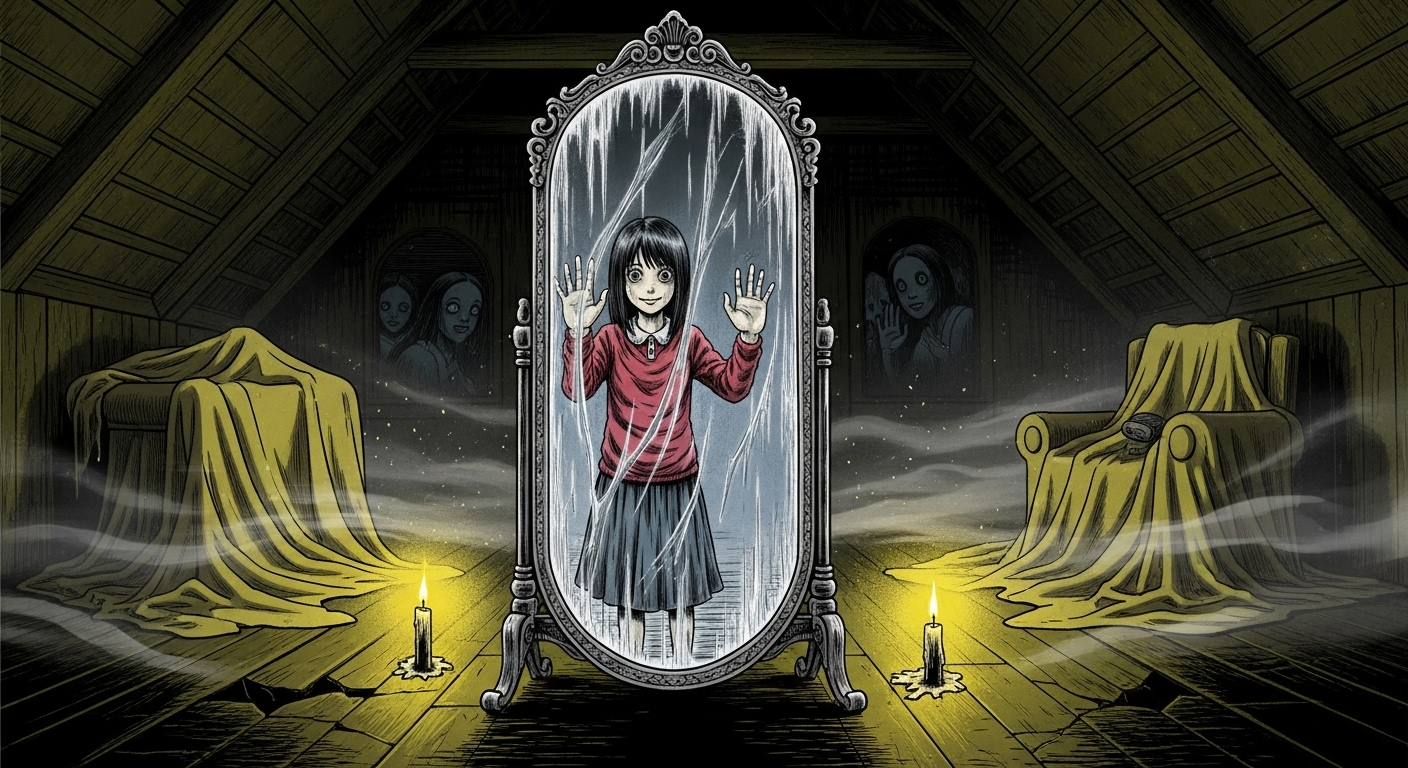
The mirror in her new room was the worst. It was tall, shaped like a door, with silver edges that had faded to black. The glass wasn’t perfectly smooth—it rippled slightly, as if frozen water had been pressed into it. She’d covered it the first night with a bedsheet, but by morning the cover was gone, folded neatly on her desk.
Her parents said it must’ve been her sleepwalking again. But Anna hadn’t sleepwalked in years.
On the third night, she woke to a faint tapping sound—soft, steady, coming from the mirror. Tap… tap… tap. Like fingernails on glass.
She sat up, holding her breath. The sound stopped.
Her reflection stood still in the dark. Then, it smiled.
Anna didn’t move. She couldn’t. Her reflection’s head tilted slowly to the side, eyes wide and glassy, smile stretching just a little too far.
Then, her reflection raised its hand and waved.
Anna screamed. Her parents came running. But when they turned on the lights, the reflection was normal again—no smile, no movement. Just her pale, terrified face.
Her father checked the windows, her mother hugged her tightly, whispering that it was just a dream. But when her mother turned off the light again, Anna could feel the reflection smiling once more, even in the dark.
The next morning, strange things began to happen.
Her toothbrush was already wet before she used it. Her shoes were moved. And on her mirror, written faintly in fog, were the words:
“HELLO ANNA.”
She wiped it away, heart pounding. But the letters came back every time she blinked.
Her parents thought she was imagining things. Her father even said she might be “acting out” because of the move. But Anna knew what she saw.
That night, she refused to sleep. She stayed up, sitting cross-legged on her bed, flashlight in hand. The house was silent except for the old grandfather clock downstairs ticking through the dark.
At 2:47 a.m., she heard the tapping again.
She aimed her flashlight at the mirror.
Her reflection was awake.
It stood there, eyes gleaming, smiling wider than before. Then, slowly, it reached its hand out and pressed its palm against the glass.
Anna’s breath fogged in front of her face. The room had gone ice-cold.
“Stop it,” she whispered. “You’re not me.”
Her reflection tilted its head. Then, with slow, deliberate movements, it wrote something on the inside of the glass.
The letters appeared backward:
“LET ME OUT.”
Anna stumbled back, shaking her head. “No… no, you’re not real.”
The reflection’s hand pressed harder. Cracks began to form across the mirror like spiderwebs. Then—silence.
Anna ran from her room, but when she reached the hallway, the other mirrors along the walls began to shimmer too. Each reflection smiled as she passed. In every single one, she saw herself—but not exactly. Some smiled, some frowned, some just stared, wide-eyed.
She screamed for her parents.
When her mother appeared, the mirrors all went still again. Just reflections. Just glass.
Her parents didn’t believe her anymore. That night, her father locked the mirror in the attic. “Out of sight, out of mind,” he said with a smile that didn’t quite reach his eyes.
But the house felt different after that—like it was holding its breath.
Days passed. The air grew colder, heavier. The mirrors stayed silent. Anna almost started to believe it was over.
Until the night of the storm.
Lightning flashed through the windows, thunder rattled the house, and in the attic, something fell.
Anna heard the crash and froze. Then came the whisper, faint but clear, drifting down the stairs:
“Annaaa…”
Her heart stopped.
She grabbed a candle and crept toward the attic door. Every step groaned. When she reached the top, the door was already open.
Inside, the old mirror stood upright again, though her father had laid it flat days ago.
Its surface shimmered like water.
Anna stepped closer. Her candle flickered wildly. In the reflection, she saw herself—but behind her stood another figure. Pale. Smiling. Eyes black as ink.
The reflection Anna reached forward again, pressing her hand against the glass. But this time, Anna’s hand moved on its own.
She tried to pull away, but her arm felt locked, drawn toward the cold surface. Her fingertips met the glass—and it rippled.
The reflection’s mouth moved, whispering words Anna couldn’t hear. Then suddenly, the glass sucked her in.
She gasped as her vision blurred, her ears filled with a deep rushing sound like wind and whispers mixed together. She fell through the mirror and hit the floor—hard.
When she looked up, she was still in her room… but everything was reversed. The world was dim and colorless.
And in the mirror—on the other side—stood her reflection, blinking as if confused.
“Wait!” Anna shouted. She banged on the glass, but her reflection only smiled… the same smile she’d seen days ago.
It turned and walked away.
“No!” she screamed, hitting the mirror again and again. But no sound came out. Only silence.
Downstairs, her parents heard footsteps and the sound of a door creaking open.
“Anna?” her mother called.
A voice answered from the hallway, soft and calm. “I’m fine, Mom. I just couldn’t sleep.”
Her parents relaxed. They didn’t see the way her reflection lingered in the hallway mirror, smiling even when her real face didn’t.
Weeks went by. “Anna” seemed happier. She helped around the house, spoke politely, even smiled for family photos—something the real Anna hadn’t done in months.
But the mirrors began to fog again. Late at night, her parents would hear faint tapping from the attic.
Once, her father went to check. When he came back down, he looked pale and shaken. He told no one what he saw.
The real Anna was still trapped.
Inside the mirror world, everything was gray and cold. She wandered from room to room, seeing her house—but not quite. Furniture was twisted, shadows stretched too long, and whispers followed her everywhere.
Sometimes, she saw faces in the glass—other people, pale and motionless, trapped just like her. Their eyes pleaded silently for help.
She screamed until her voice broke. No one heard her.
Until one day, she saw something new.
Her reflection—the other Anna—stood on the other side of the mirror again, looking straight at her.
“Please,” Anna begged. “Let me out.”
Her reflection tilted its head. Then smiled.
And wrote, slowly, on the inside of the glass:
“Your turn now.”
The reflection’s eyes darkened. The glass shuddered—and then, it was gone.
The world faded completely dark.
Months later, the family moved away. The house stood empty, except for one thing left behind in the attic—the mirror.
When new owners finally came, they found it there, covered in dust.
Their daughter, a cheerful girl named Lucy, ran her fingers along the glass.
“Mom!” she called. “There’s something written here!”
The words, faint and backward, spelled out:
“HELLO LUCY.”
And when Lucy smiled, the reflection smiled back—just a little too soon.