
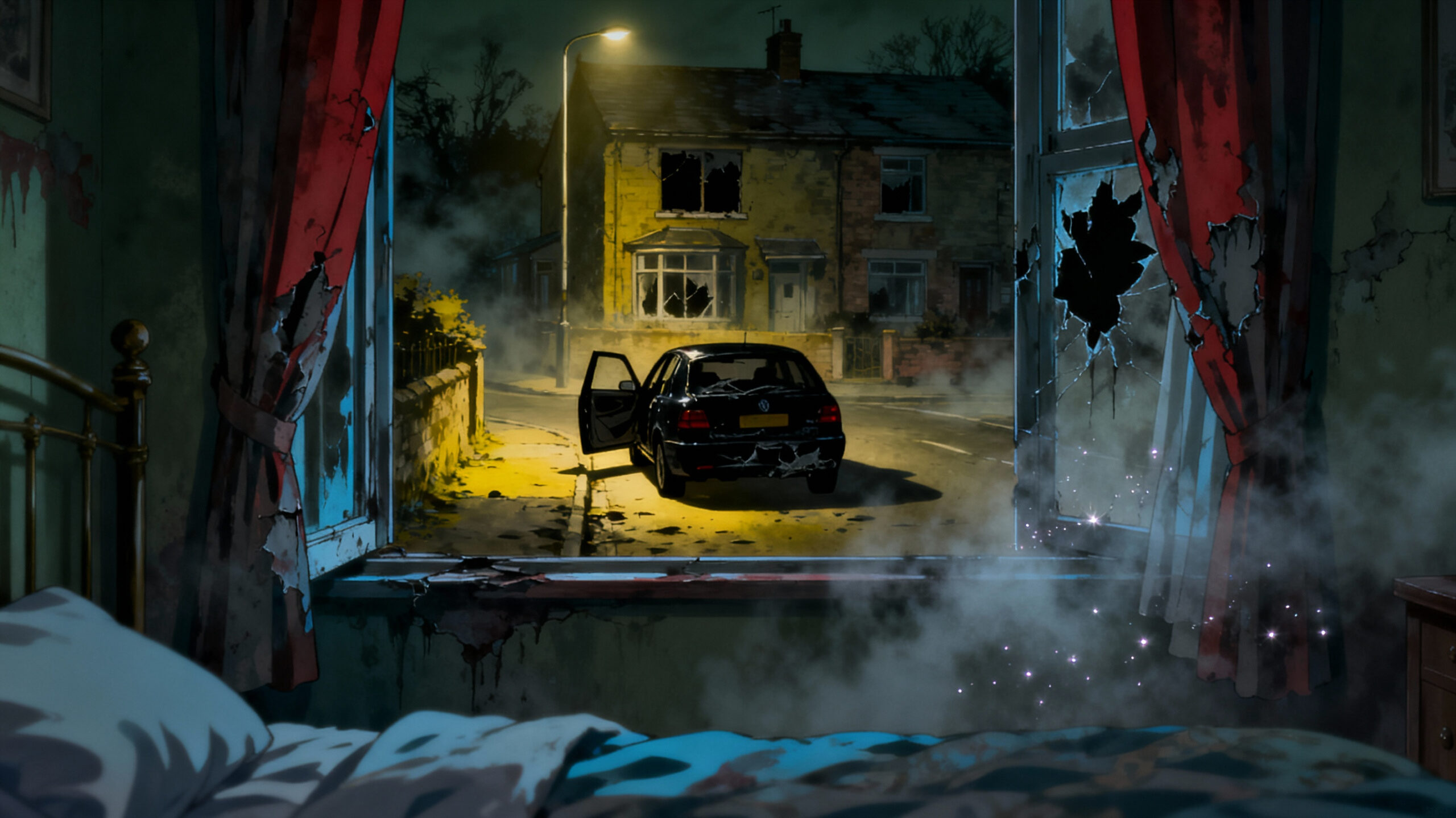
A black car waited on the street again, its headlights off, its windows dark like a pair of watching eyes.
Tom noticed it first on a rainy Wednesday night when he couldn’t sleep. He had gone to the window for air, pushing the curtain aside just enough to peer out. The quiet street in his small UK town was usually empty after ten, but there it sat. A black car. Parked right across from his house. Motionless.
He didn’t think much of it at first. Maybe someone visiting a neighbour. Maybe someone waiting for a friend. But the next night, it was back. Same spot. Same stillness. And on the third night, when he pulled the curtain open just a little too fast, he felt a jolt run through him. The car hadn’t just been there. It felt like it was already looking at him.
He told himself he was being silly. Cars parked on streets all the time. But each night it returned, and each night Tom watched it longer. He began waking up at the same hour—2:13 a.m.—as if the sound of its engine turning off echoed through his dreams. He never heard it arrive. Never heard it leave. It was simply there, and then gone before sunrise.
By the end of the week, the sight of it made his stomach twist. The streetlights left long shadows across the car’s roof. The windows were always too dark, even when the rest of the street reflected faint gold from the lamps. He never saw anyone inside.
He tried telling his parents, but his mum only frowned and said it was probably someone working late shifts. His dad joked about secret agents. Tom didn’t laugh.
He started checking earlier in the evening. Nine. Ten. Eleven. Midnight. No car. But around that same time every night, when the town fell into its deepest quiet, it showed up again.
One night, he decided he wouldn’t look. He would stay in bed. He would keep his eyes shut. But as the minutes dragged by, he felt a prickling along his arms. A pressure. Like someone was expecting him. His heart beat faster.
He got up.
He pulled the curtain aside an inch.
The car sat exactly where it always did.
But this time, something was different.
The back door was open.
Tom froze. The open door faced his house, angled toward his bedroom window. The inside was pure black, darker than the night around it. Like it swallowed the light.
He waited for a person to step out. Or step in. Or close the door. But nothing moved.
He stayed at the window until his eyes burned.
Finally, he crawled back to bed, but he didn’t sleep.
The next morning, when he left for school, he glanced at the curb. The car was gone, of course. No marks on the road, no sign anything had been there. He tried to shake off the memory of the open door, but it stayed with him like a cold breath on his neck.
That night he forced himself to stay awake until the usual time. When the clock struck 2:13, he moved slowly to the window, palms sweating, breath shallow.
The street was empty.
A wave of relief washed over him. Maybe it was over. Maybe whoever it was had moved on.
He was about to step away when he noticed something odd. A scrap of white against the pavement. He leaned closer. There, right where the car always parked, lay a folded piece of paper. No breeze moved it, even though the trees shook softly in the wind.
Tom hesitated. Then he crept downstairs, careful not to wake his parents, and unlocked the front door. He stepped outside barefoot, the cold ground biting his skin. The paper sat still on the street, waiting.
He bent down and picked it up.
It was a photo.
His house. His street. Taken from the exact place where the car always parked.
And in the window—his window—he saw himself standing there. Pale. Eyes wide. Looking straight at the camera.
The photo shook in his hands. He had never seen anyone outside. Never heard a camera. But the picture was sharp and close, clear as day.
He backed away, almost tripping over the curb, and sprinted inside. He locked the door twice and ran upstairs.
He shut the curtains tight.
For hours he lay awake, heart hammering, waiting for the sound of a car engine outside. Nothing came.
But just when he felt the exhaustion pull him toward sleep, he heard it.
A quiet tap against the glass.
He didn’t move. His breath stopped. Another tap. Soft. Slower this time.
He pulled the covers up to his chin. The tapping came again, a gentle knock as if someone wanted him to open the curtains.
Tom squeezed his eyes shut.
The tapping stopped.
Morning came with pale light and birds outside. Tom opened the curtains with shaking hands.
No car. No person. Just the empty street.
But on the windowsill, caught under a small stone, lay another photo.
This one wasn’t of the house.
It was of the inside of his room.
Taken from where he had stood last night.
Someone had been in the house.
He grabbed the photo with numb fingers. The centre of the picture showed his bed. And on it lay a figure curled up under the blankets.
Him.
But the figure’s face wasn’t visible. Only the shape of a body turned away.
Tom stared at the image until the edges blurred. He wasn’t sure when the picture had been taken. He wasn’t sure how anyone had gotten inside.
But the worst part was the small detail in the bottom corner.
A shadow on the floor. Long. Tall. Stretching from the doorway toward the bed.
It wasn’t his.
The story’s final line settles like cold air:
Tom realised the car hadn’t been watching his house at all—it had been watching him.