
The first thing Aarav saw was the trail that hadn’t been there yesterday.
It cut through the dry leaves behind his grandparents’ house, thin and pale, as if something heavy had been dragged across the forest floor. He didn’t know why it made him stop. Maybe it was the way the trees bent toward it, their branches leaning in like curious listeners.
Aarav was visiting for a week during school break. The village was small and peaceful, and nothing strange ever happened there. But the trail looked fresh. New. Like it wanted to be followed.
He stood there for a moment, listening. The morning was warm and still. A few birds called from far away, but the part of the forest in front of him felt too quiet. He took a small breath and stepped onto the path.
The dry leaves crunched under his shoes. The air smelled earthy and old, like the ground had been turned over recently. The trail twisted between the trees in a slow curve, always just a little farther than he thought.
After a few minutes, he paused. He didn’t remember the forest being this dense. The trees here were taller, with thick vines curling around them. Sunlight struggled to reach the ground.
He felt the hairs on his arms lift.
A low tapping sound came from ahead. Soft. Hollow. Like knuckles knocking on wood.
Aarav swallowed and followed it.
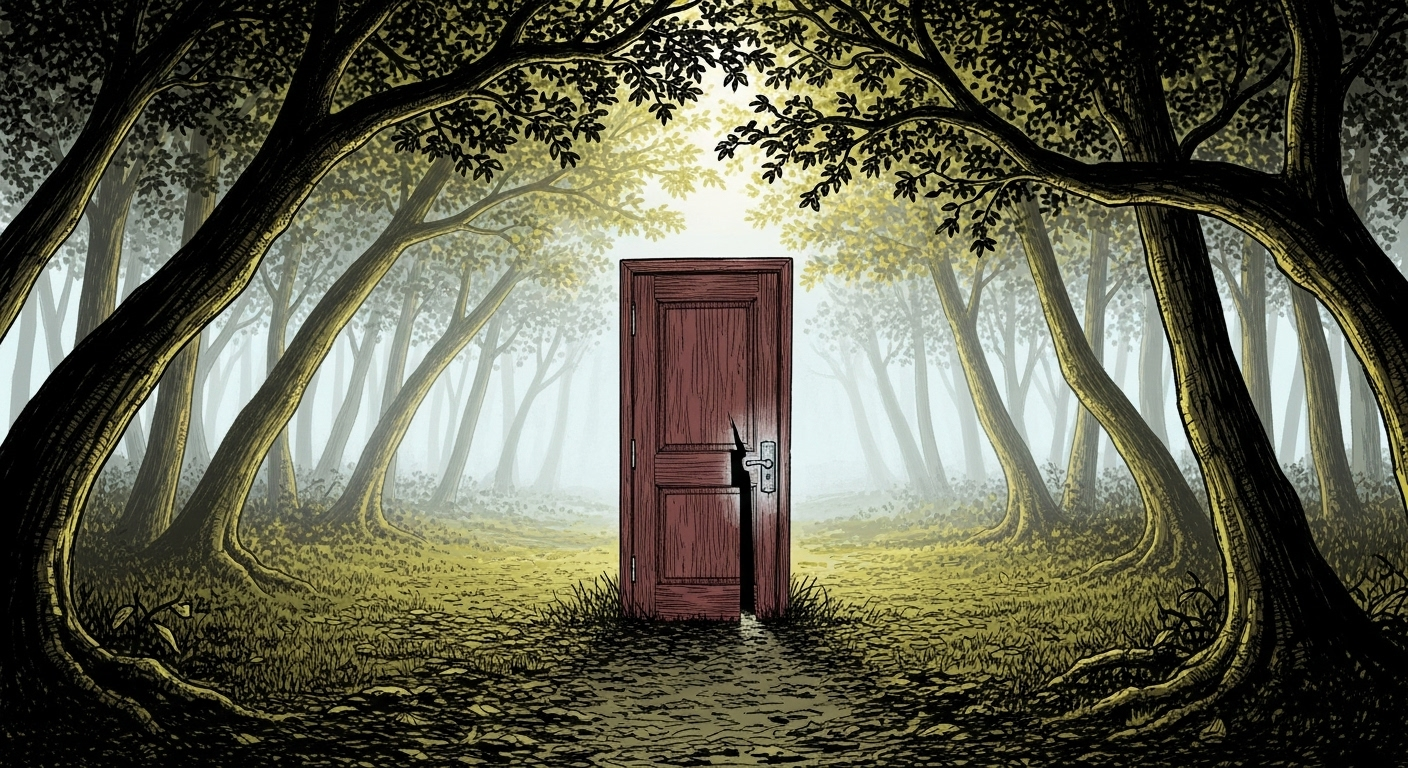
The trail opened into a small clearing. At the center stood a door.
Just a door.
No frame. No walls. Nothing holding it up. A tall wooden door, dark brown, with a brass handle. It stood on the forest floor as if someone had planted it there.
Aarav froze.
The door didn’t look old. It looked used, polished by hands. A faint line in the dirt showed where it had scraped the ground recently.
The tapping sound came again. This time from the other side.
He stepped back, heart thumping. Nobody lived this deep in the forest. There were no cabins, no huts. Just trees and silence.
The tapping stopped.
Aarav turned as if he might leave. But something uneasy pulled at him. A strange pressure in the air. The door didn’t feel like a decoration or a prank. It felt like it was waiting.
He picked up a small stone and tossed it toward the door. It hit with a dull thud, like hitting the side of a real house.
The sound shouldn’t have echoed, but it did. A soft, long echo that slid between the trees.
Aarav stepped closer, drawn in even though he knew he should run back home.
The handle twitched.
He jumped back, almost tripping. His breath came out in a shaky gasp.
“Hello?” he called.
The forest swallowed the word.
His voice sounded too loud here, like the trees didn’t want any sound to break their stillness.
A slow creak came from the door. It parted just a little. A thin shadow leaked out—just darkness, nothing else.
Aarav’s chest tightened. Every instinct told him to run, but his legs stayed locked.
Something whispered from behind the door. A tiny sound, like leaves brushing each other. Or someone breathing in the dark.
He took a single step back. Then another.
The door opened wider on its own, steady and slow. Not pushed. Not pulled. Just moving, like it was breathing.
Aarav turned and walked away. Not fast at first. He didn’t want to make noise. The forest felt sharper now, as if every branch was leaning toward him. The path behind him stretched long and dark.
He walked faster.
Leaves crackled under his feet. His heartbeat thudded in his ears. He didn’t look back. He didn’t want to see how wide the door had opened.
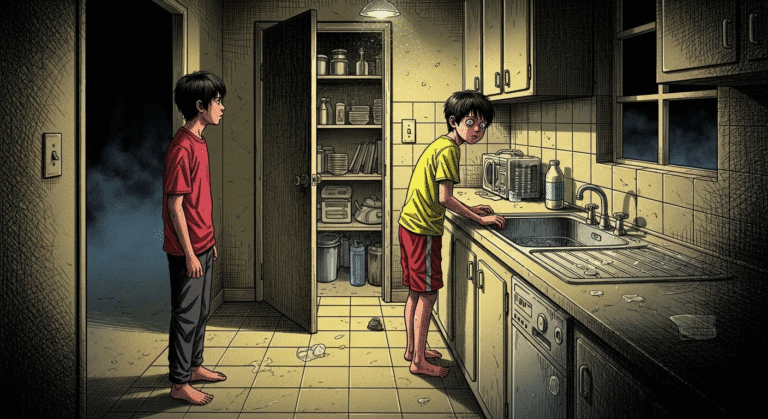
When he reached his grandparents’ house, he ran inside. His grandmother looked up from the kitchen table.
“You’re back early,” she said. “Everything alright?”
He tried to nod. But his voice shook when he spoke.
“There’s something in the forest.”
Her face tightened. She exchanged a look with his grandfather, who had been reading the paper.
“What did you see?” his grandfather asked gently.
“A door,” Aarav said. “Just standing there. It opened.”
His grandparents went still. His grandfather folded the paper slowly. His grandmother’s hands gripped the edge of the table.
“You followed a trail?” she asked softly.
“Yes.”
His grandfather stood and locked the back door. Then the windows. Then the front door. He moved with calm, practiced motions.
Aarav watched, confused. “You know about it?”
His grandmother nodded. “Sometimes the forest makes a path,” she said. “It leads to places that aren’t meant for people. If you follow it, it always shows you a door.”
“What’s behind it?” Aarav asked.
His grandmother shook her head. “Nobody knows. Nobody who opened it stayed long enough to tell.”
Aarav felt his throat tighten. “It followed me,” he whispered. “I didn’t open it.”
His grandfather looked at him with tired eyes. “Not yet.”
That night, Aarav couldn’t sleep. Every time he closed his eyes, he saw the door. The way it stood alone. The way it opened by itself. The way the darkness behind it felt alive.
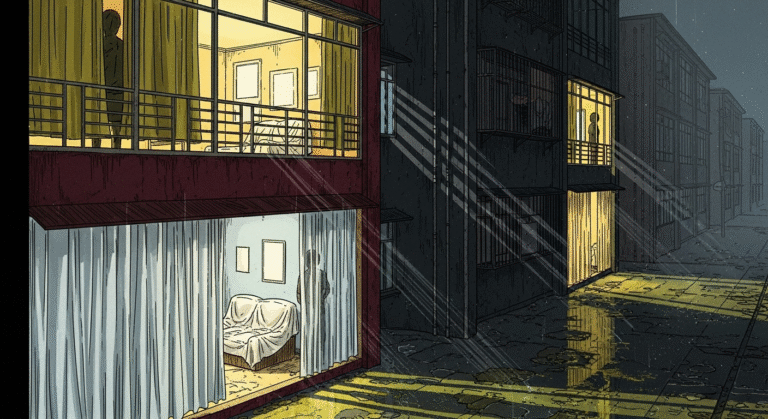
He got up and went to the window. The forest loomed beyond the backyard, a black wall against the sky.
Something pale flashed between the trees.
Aarav leaned closer.
A thin line of light glowed faintly in the forest, as if a door had cracked open and was shining from its center.
He backed away from the window, his breath stuck in his throat. The glow pulsed once, like it had noticed him.
He shut the curtains with shaking hands.
The house was silent.
But in the distance, hidden behind the trees, the door creaked open a little wider.
Aarav didn’t see it.
He only felt that quiet sound settle into the night, patient and soft, as if the forest was waiting for him to return.