
I work in IT support for a mid-sized insurance firm in Manchester, basically the kind of place where nothing interesting ever happens. I mean, our biggest excitement is usually someone forgetting their password for the third time that week. So when they announced the Christmas party at the old Westwood Building downtown, everyone was pretty excited. Free drinks, catered food, you know the drill.
The party was fine. Honestly, a bit boring if I’m being real. My manager gave a speech about teamwork, someone from accounting got too drunk and cried about their ex, the usual corporate Christmas nonsense. I spent most of the night talking to Jenny from HR and Marcus from payroll, trying to avoid our department head who always corners people to talk about his boat.
It wasn’t until the next Monday that things got weird.
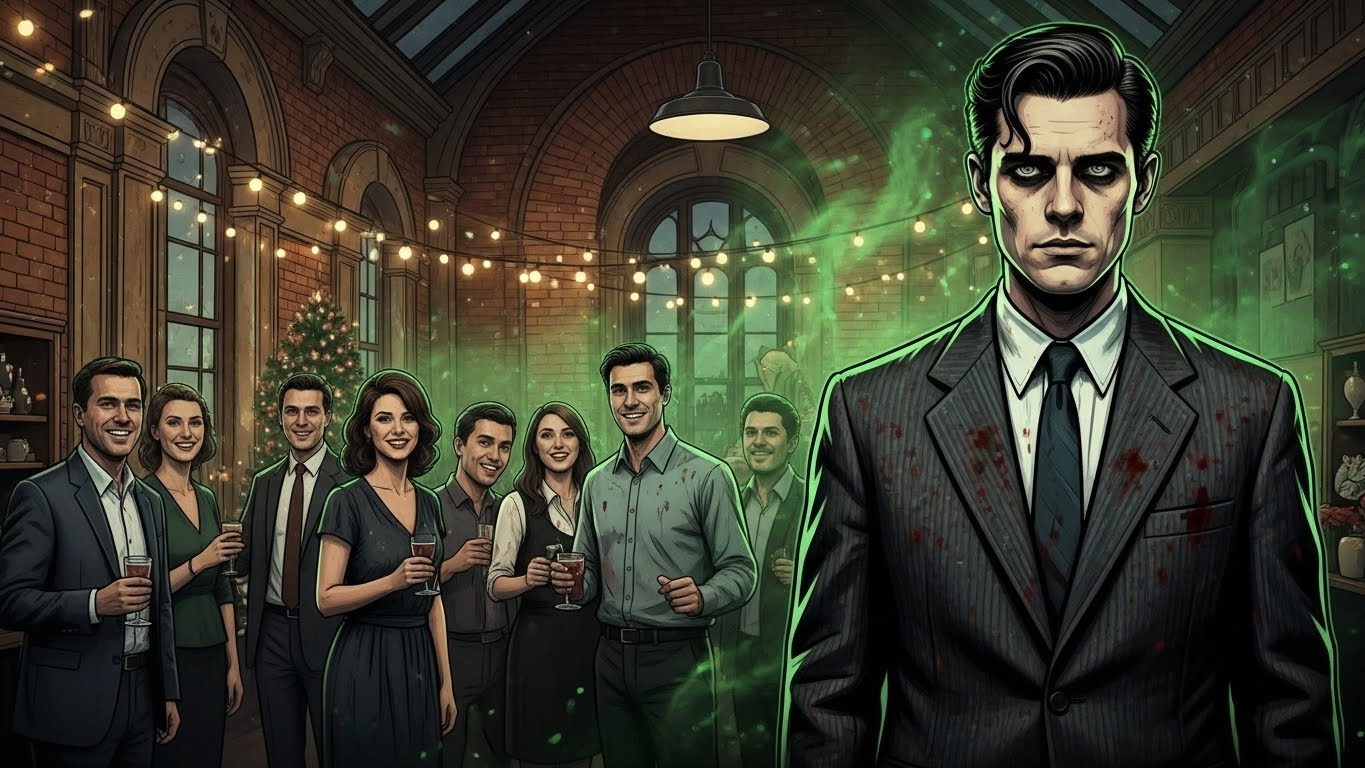
Sarah from marketing had posted the photos in our company Slack channel—maybe forty pictures from the party. I was scrolling through them during my lunch break, looking for the one where I’d actually smiled properly, when I noticed him.
A man standing in the back of one of the group photos. Dark suit, thin tie, slicked-back hair. The odd thing was his clothes looked old. Not vintage-trendy old, but genuinely old-fashioned, like something from an old film. 1950s, maybe.
I clicked to the next photo. There he was again, further to the left this time. Same suit, same distant expression.
“That’s weird,” I muttered, scrolling faster now.
Every single group photo. Every. Single. One.
He was always in the background, always slightly out of focus, always wearing that same dark suit with the thin tie. But here’s the thing—I didn’t remember seeing him at the party. And I’d been there all night.
I sent a message to the group chat: “Who’s the guy in the suit in all these photos?”
The responses came quickly.
“What guy?”
“Which photo?”
I felt my heart sink a little. “The one in the back. Dark suit. He’s in every group photo.”
Jenny replied: “Are you feeling okay? Maybe you need more coffee lol”
But then Marcus chimed in: “Wait. I see him. Holy shit, who IS that?”
Within minutes, half the office was crowding around my desk. Some people saw him immediately. Others had to stare for ages before they spotted him, like one of those magic eye pictures. But once you saw him, you couldn’t unsee him.
“He wasn’t at the party,” Sarah said quietly. She’d taken most of the photos. “I would have noticed someone dressed like that.”
“Maybe he works in the building?” someone suggested. “Just wandered into the background?”
Looking back, I wish we’d stopped there. I really do.
Instead, I spent that evening researching the Westwood Building. It was one of those Victorian brick places that had been converted into office space in the eighties. Before that, it had been offices since it was built in 1923.
I found an old newspaper article from December 1952. My screen flickered, and I had to zoom in to read the grainy text.
“LOCAL MAN FOUND DEAD AT COMPANY PARTY”
The article was brief. A man named Thomas Aldridge, 42, had been found dead in the third-floor bathroom during his company’s Christmas celebration. He’d been fired earlier that day—budget cuts, apparently. He’d shown up to the party anyway, gotten drunk, and killed himself before anyone noticed he’d gone quiet.
I should have closed my laptop right then. Obviously, I should have. But I kept digging.
Twenty minutes later, I found what I was looking for: an employee directory from 1952, preserved in the Manchester Archives digital collection. There was a photo of Thomas Aldridge.
Dark suit. Thin tie. Slicked-back hair.
The same man from our photos.
My hands were shaking as I screenshot the image and sent it to the group chat with no explanation.
Jenny called me immediately. “That’s him. That’s exactly him.”
“He’s been dead for over seventy years,” I said.
“Stop it. This isn’t funny.”
“I’m not joking.”
The line went quiet for a moment. Then: “We need to delete those photos.”
But here’s the thing—we couldn’t. Sarah tried first. Every time she selected a photo to delete, her phone would freeze. Marcus tried on his computer. Same thing. The photos wouldn’t delete, wouldn’t move, wouldn’t do anything except sit there with Thomas Aldridge staring out from the background.
The next day, new photos started appearing in the Slack channel. Photos none of us had taken. They were from the party, definitely—same decorations, same room—but from angles we hadn’t captured. And in every single one, Thomas Aldridge was closer to the camera. Not in the background anymore. Closer.
By Friday, someone had called the building management. They seemed unsurprised, which was somehow worse than if they’d been shocked. “Yeah,” the manager said flatly. “We get that sometimes. Usually around Christmas. Just ignore it.”
I wish I’d asked what happens if you don’t ignore it.
Last week, someone from accounting—someone who wasn’t even at the party—found a photo on their phone. Just one photo. Them sitting at their desk, working. And standing right behind their chair, close enough to touch their shoulder, was Thomas Aldridge in his dark suit.
They handed in their notice the same day.
I still work here. I need the job, you know? But I’ve stopped going to company events. And I’ve turned off photo backups on my phone. Sometimes, late at night when I’m finishing up a ticket, I feel like someone’s standing behind me. I never turn around to check.
To this day, I still see him sometimes when I scroll too quickly through my camera roll. Just for a second, in photos he shouldn’t be in. Getting closer each time.
I should have trusted my instincts and deleted those photos the first day. But maybe it wouldn’t have mattered. Maybe he’d already noticed us noticing him.
Maybe that’s all it takes.