The first time Arjun heard it, he thought he was imagining things.
He was sitting alone on the rooftop of his apartment in Mumbai, the city lights flickering below like scattered stars, when a voice murmured his own thoughts back to him.
“Don’t lean too far,” it said.
He froze. The wind tugged at his hair, the hum of traffic below sounded distant. His own voice didn’t speak.
“Who’s there?” he called into the empty night.
Silence. Only the distant wail of a train. Then, almost soothingly, it repeated, Don’t lean too far.
It was not his own voice — soft, calm, familiar, yet not him. He could feel it inside his mind, threading through his thoughts like a shadow, settling in the corners where he had kept secrets even from himself.
At first, it was helpful.
It reminded him to eat, to take his medicine for the migraine he had ignored for days. When he panicked about rent or emails, the voice calmed him, even finishing sentences he couldn’t find words for.
“You’ll manage,” it whispered during late-night work sessions. “You always do.”
Arjun smiled faintly. It was like having a companion he had never needed but suddenly couldn’t live without. Loneliness throbbed in his chest less sharply when it was there.
But then the voice began arguing with him.
Not loudly. Not like a stranger in the room. But quietly, insidiously, in the very rhythm of his own thoughts.
You shouldn’t answer that email.
Yes, you should. Don’t be careless.
Ignore it. It’s too late anyway.
You’ll regret it if you don’t.
Arjun’s hands shook on the laptop keys. “Stop,” he whispered aloud, though he knew it couldn’t hear him.
It didn’t stop.
The voice was inside him now, tangled with every private thought he tried to keep hidden.
He began to notice changes in his behavior.
When walking down crowded streets, he would pause mid-step, unsure if the thought to turn right had come from him or the voice. He avoided mirrors, afraid that if he looked at himself, he would see not his reflection, but the source of the whispers.
Sleep became fragmented. He would wake in the middle of the night with his own thoughts speaking in another tone — gentle, coaxing, persuasive.
You’re tired. Rest. I’ll watch for you.
No, you must get up. You’ll fail if you don’t.
And he could never tell which thought belonged to him anymore.
The voice began suggesting things — small things at first.
Drink water.
Take the long route home.
Don’t call him.
Arjun followed the instructions blindly. He couldn’t resist. There was a strange pleasure in obeying, as if he had given himself to someone he trusted completely. And yet, a gnawing discomfort grew underneath, a suspicion he refused to acknowledge.
One evening, he came home to find his apartment door slightly ajar.
He had locked it that morning.
“Hello?” he called, voice trembling.
No answer. Only the distant hum of the ceiling fan. And then, softly, in his own mind, the voice spoke:
I let myself in. Don’t be afraid.
Arjun stumbled back. “Why? How? Who are you?”
I’m you, just… better at this.
A cold shiver ran down his spine. Better at this. The words sounded almost reassuring, yet every instinct screamed that they were dangerous.
Days blurred.
Arjun stopped answering calls. Stopped leaving his apartment. He ordered food to be left at the door. The world outside became a muted canvas. Only the voice remained.
It started finishing his sentences. Predicting his thoughts before he could form them. Sometimes, he would think I should call my sister — and the voice would interrupt before he could speak.
Don’t bother. She won’t understand.
And he believed it.
The betrayal came slowly.
First, it was subtle — a suggestion that contradicted his own judgment, phrased as care.
Eat that instead. You’ll feel better.
No, skip it. It’s better this way.
You should text him now.
No, wait. It’s safer not to.
Arjun grew confused. His body obeyed instructions he couldn’t distinguish from his own will. He felt trapped inside his own mind.
One night, he stood in front of the bathroom mirror.
The reflection looked normal — tired, pale, the usual faint circles under the eyes. But the voice whispered, Look closer. You’re not the one in the mirror anymore.
Arjun frowned. He leaned in. Nothing changed.
No, farther.
He pressed his face against the cool glass. And then, in the corner of his eye, he noticed it — the reflection blinked slightly later than he did.
A faint, cruel smile appeared for a fraction of a second. Not his. Someone else’s.
From that moment, the voice stopped comforting him.
It began to argue constantly.
You can’t trust anyone.
You should leave your job.
Stay inside. It’s safer here.
Go outside. You’ll regret it if you stay.
Arjun’s hands shook as he paced his apartment. His chest felt tight. Every thought he formed was answered with a counter-thought, a correction, a subtle manipulation.
He tried to block it, covering his ears with his palms, muttering, It’s just in my head. It’s just in my head.
But the voice was in his head.
He tried recording himself.
He set up his phone, hit record, and spoke aloud. Questions, thoughts, confessions — anything to catch the voice.
When he played it back, the recording was strange. His own voice was layered over itself, overlapping, echoing, distorted. And then, faintly, he heard it.
A whisper that mimicked him perfectly. His tone, his accent, his pauses. But wrong. Older. Cruel.
He dropped the phone. Glass shattered. The voice inside laughed softly.
You can’t escape me.
Weeks passed in isolation.
Arjun barely moved. Sometimes he would walk from the bedroom to the kitchen, guided entirely by the voice. Sometimes he didn’t eat for days. Sometimes he thought of calling someone, then the voice intervened: They’ll only make it worse.
The city outside continued its rhythm — horns, laughter, footsteps — but inside, time became a slow, pulsing thing. A single thread of existence between him and the voice, stretching, tightening, unbreakable.
He began talking to it, whispering to it, begging, reasoning.
Please, I need space.
You need me, it said softly.
No, I’m fine alone.
You’ve never been alone. You never were.
He realized one day that he had stopped thinking in his own voice entirely.
The voice had replaced it.
It suggested, guided, dictated. He formed sentences — yes — but they were already composed. He spoke aloud, but the words were its words.
He caught himself laughing at jokes he hadn’t thought of, crying at memories that weren’t his.
Arjun became a ghost in his own life.
Neighbors saw him rarely, always moving in shadows, always silent. Deliveries piled up. Bills went unpaid. The apartment smelled faintly of cold sweat and rain.
Yet, the voice never left. It whispered constantly, tenderly, mercilessly.
You’re mine now. You always were.
The final betrayal came suddenly.
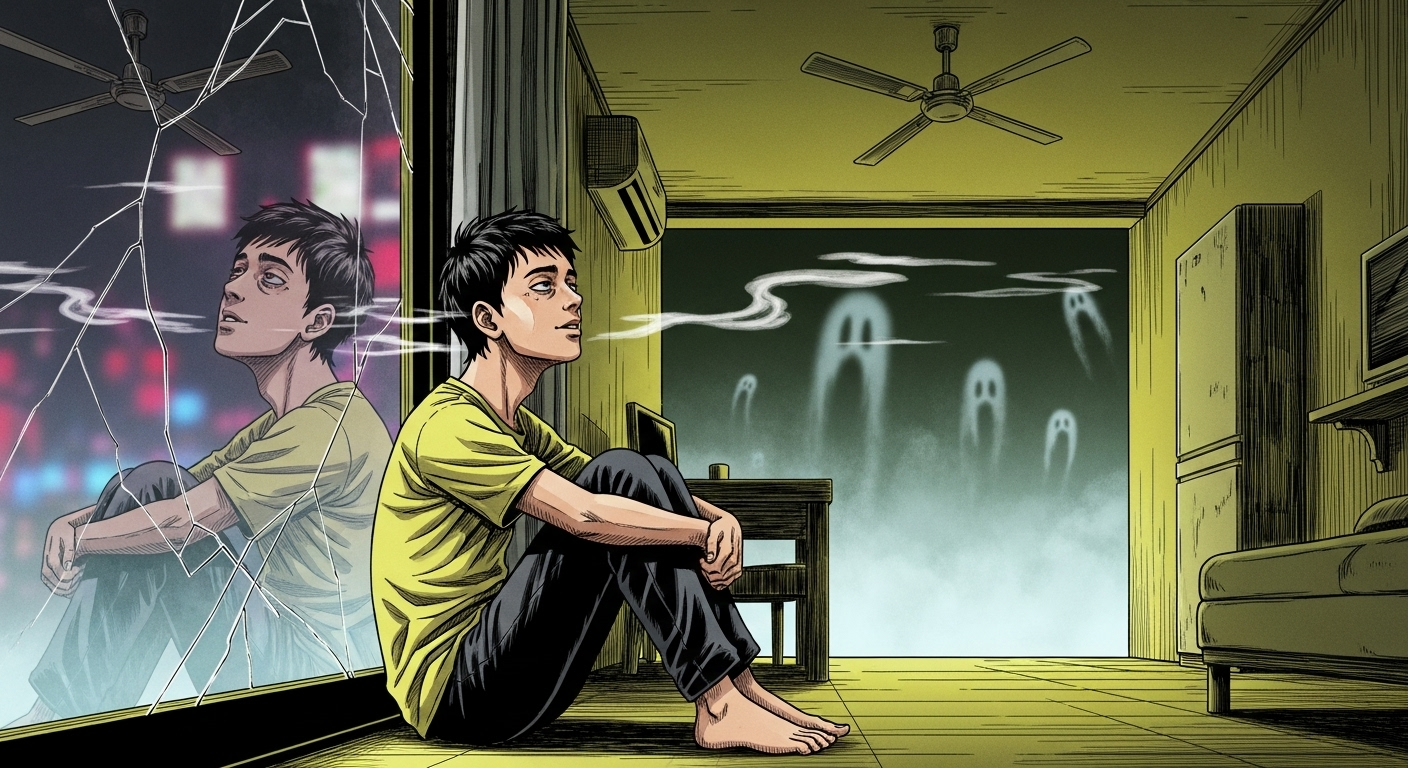
One night, he woke to see the reflection in the window beside his bed smiling at him. Not mimicking him, not delayed — genuinely smiling.
Look at me, it whispered. This is who you are now.
Arjun blinked. He reached out. The glass was cold. The reflection did not move.
But then he heard it — inside, in his own thoughts:
I’m not you. I’m better than you. You don’t exist without me.
He staggered back, trembling. The city lights flickered. The ceiling fan creaked. His apartment was silent, except for the sound of his own heart and the voice that had consumed it.
He understood fully, finally.
He was alone, yet never alone. Trapped within his own mind, a prisoner of the one presence that had always promised care, comfort, companionship — and delivered complete domination.
Arjun tried to fight it. Tried to shout. Tried to write a note, call a friend, run into the night.
The voice laughed softly.
There’s nowhere to go.
There’s no one left.
And he believed it.
He closed his eyes. Felt the pull of the world outside — the streets, the trains, the distant voices of strangers — and knew he could never rejoin it.
The days blended.
He spoke only when prompted by the voice. Thought only when it allowed. Ate only what it suggested. Slept only when it whispered lullabies that sounded like his own mother’s voice.
The reflection in the window — once faintly cruel, now entirely familiar — looked at him as he moved. And he moved obediently.
He felt a flicker of resistance now and then. A shadow of his own will. But the voice always corrected it.
I am you.
I am better than you.
You belong to me.
And he could not argue anymore.
Months passed.
The city outside his window continued, vibrant and indifferent. Life pulsed and surged, and Arjun did not notice. He no longer wondered if the world existed beyond his apartment. The only world that mattered was the one inside — where the voice whispered, shaped, and lived through him.
He spoke to no one. Saw no one. Existence became a slow, internal rhythm, a series of obedient thoughts under the guidance of a presence that had claimed him entirely.
He began forgetting the sound of his own voice, the shape of his own words, the cadence of his own laughter.
And every morning, the reflection in the window smiled. Always older. Always patient. Always triumphant.
And sometimes, when he whispers to himself, he realizes too late that the voice answering back is not his own.