I’ve been working at SecureSpace Storage in Bangalore for about three years now. It’s not glamorous, but it pays the bills. Most days, I just sit at the front desk, sign people in, and occasionally help them move boxes. Pretty straightforward, you know?
Last month, my manager Mr. Sharma called me into his office. “Arjun, I need you to clean out unit 213,” he said, not meeting my eyes.
“The one in the basement level?”
He nodded. “Rent hasn’t been paid in six months. We need to clear it out, inventory everything, the usual procedure.”
Something about his tone felt off, but I didn’t push it. I mean, it was just another abandoned unit, right?
The basement level always creeped me out a bit. The fluorescent lights buzzed constantly, and there was this weird echo that made every footstep sound like someone was following you. Unit 213 was at the very end of the corridor, naturally.
I unlocked the heavy metal door and pulled it up with a groan. The smell hit me first—stale air, like the unit had been sealed for years instead of months. I flipped on my flashlight, expecting the usual chaos of forgotten belongings.
But unit 213 was empty.
Completely empty, except for two things sitting in the exact center of the concrete floor: a simple wooden chair facing the door, and a video camera on a tripod pointing at the chair.
The red recording light was still blinking.
“That’s weird,” I muttered, my voice echoing in the empty space. Looking back, I should have just grabbed the stuff and left. But curiosity got the better of me.
The camera was an older model, the kind that records onto SD cards. I checked the battery—somehow still at forty percent. I didn’t want to seem paranoid, but my hands were shaking slightly as I ejected the card and pulled out my phone to check the footage.
The file directory showed hundreds of video files, dated back over six months. Each one was exactly eight hours long, timestamped from 11 PM to 7 AM.
I opened the most recent file from last night.
For the first few hours, it was just what you’d expect—an empty chair in an empty room, the timestamp ticking forward in the corner. I fast-forwarded, watching the numbers blur. 11:47 PM. 12:15 AM. 1:08 AM. Nothing. Just the chair and the bare concrete walls.
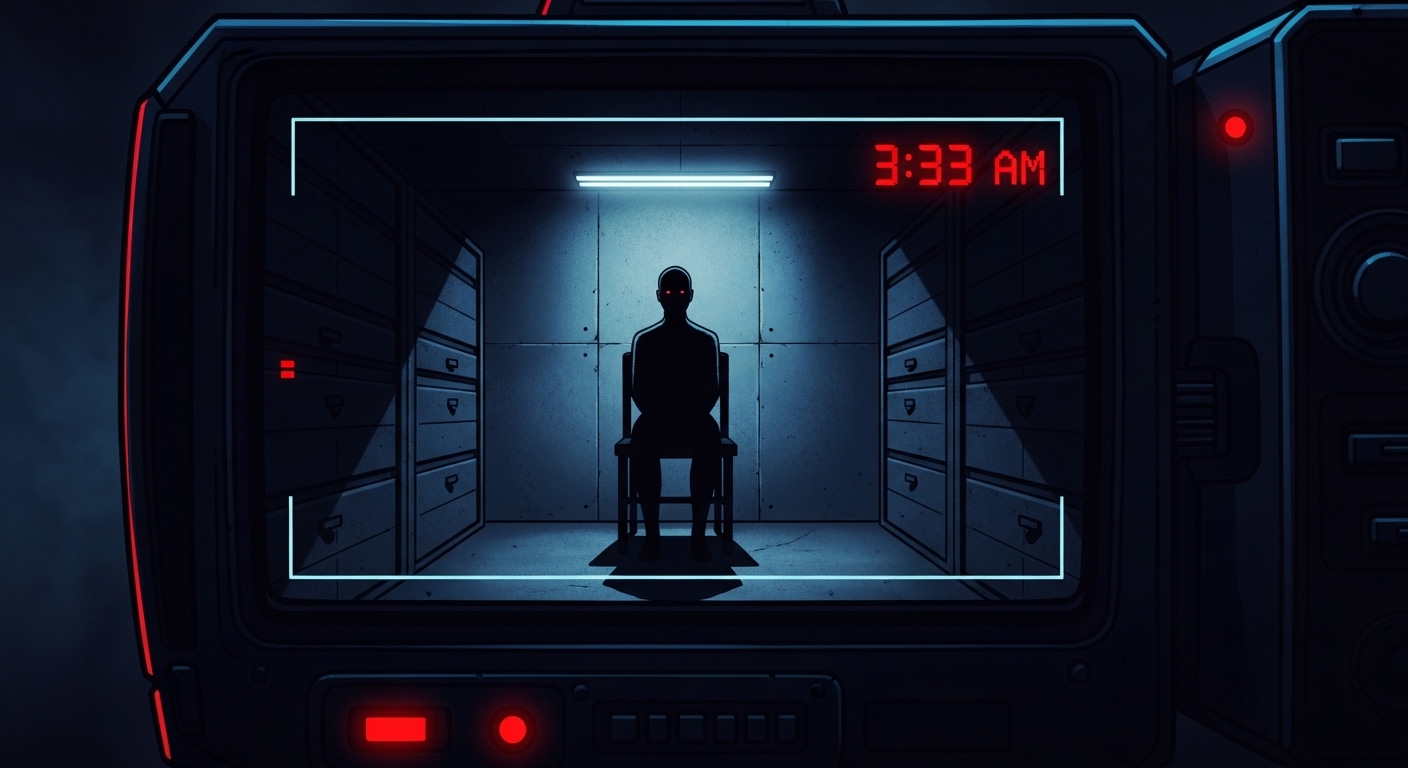
Then at 3:33 AM, someone was sitting in the chair.
I felt my heart drop.
I hadn’t seen them appear. One frame the chair was empty, the next frame someone was there, perfectly still, staring directly at the camera. I couldn’t make out their face clearly—the image was grainy—but their posture was wrong somehow. Too rigid. Too still.
They sat there for exactly three minutes, not moving, not blinking as far as I could tell. At 3:36 AM, the chair was empty again.
Maybe I was just paranoid, but I checked another file. Same thing. 3:33 AM, someone in the chair. Three minutes. Gone.
I went back weeks. Every single night. Same time. Same three minutes.
“This is insane,” I whispered.
I called Mr. Sharma. “Sir, did you know there was a camera in unit 213?”
A long pause. “Just clear it out, Arjun. Today.”
“But there’s footage of—”
He hung up.
I should have left right then. Instead, I checked the previous night’s footage one more time, and that’s when I noticed something I’d missed. In the reflection on the camera lens, barely visible, I could see the unit door. It was closed. Locked from the inside.
Whoever was sitting in that chair every night was locking themselves in.
I heard a sound behind me—a soft scraping, like wood dragging across concrete.
I spun around. The chair had moved. I know it had. It was facing a different direction now, angled slightly toward me instead of the door.
My phone buzzed. A message from an unknown number: “3:33.”
I looked at the time. 3:31 PM.
“No, no, no,” I backed toward the door, my legs feeling like lead. The temperature in the unit had dropped. I could see my breath.
The camera’s red light blinked faster.
3:32 PM.
I grabbed the chair and the tripod, my hands fumbling. I didn’t care about protocol anymore. I just wanted out. The camera slipped, and as I caught it, the viewfinder flipped on, showing me the live feed.
In the small screen, I saw myself, panicked, gathering the equipment. And behind me, in the corner of the unit that I knew was empty, the viewfinder showed a figure standing perfectly still, watching me.
I didn’t look back. I ran.
I left everything in the corridor and took the stairs two at a time. When I reached the ground floor, I went straight to Mr. Sharma’s office and quit on the spot. He just nodded, like he’d been expecting it.
“You’re the fifth person I’ve sent down there,” he said quietly. “You lasted the longest.”
I moved back to Mumbai two weeks later. Got a job at a call center. Better pay, actually. But to this day, I still can’t look at empty chairs the same way. And I never, ever check the time at 3:33, morning or afternoon.
Sometimes, late at night, I wonder who’s sitting in that chair right now, staring at a camera in an empty unit. And worse—I wonder if they’re still watching the footage.
If they know who I am.
Just last week, I found a wooden chair in the hallway outside my apartment. It was facing my door.
I moved it to the building’s storage room, but honestly? I’m thinking about moving again.