
I was twenty-two when I took the summer job at Camp Nilgiri, basically because I needed the money and figured two months in the Western Ghats would be good for my resume. You know, “leadership experience” and all that. The camp was tucked away in the dense forests near Ooty, the kind of place where cell service died the moment you crossed the main gate.
The head counselor, Rajesh, gave me the tour on my first day. Everything seemed normal—archery range, dining hall, rows of wooden cabins painted cheerful yellow and blue. Then we walked past Cabin 13.
It stood apart from the others, half-hidden by wild undergrowth. The windows were boarded up, and someone had painted “CLOSED” across the door in faded red letters.
“What’s that about?” I asked.
Rajesh didn’t even look at it. “Storage. Never gets used. Don’t worry about it.”
Something about how quickly he answered made my stomach tighten, but I didn’t push. I mean, I’d just arrived. I didn’t want to seem difficult.
The first week went fine. Seventy kids between ages ten and fourteen, all excited about campfires and nature walks. I was assigned to Cabin 7 with eight girls who wouldn’t stop talking about some TikTok trend I didn’t understand. Normal summer camp stuff.
Then, about nine days in, one of my girls—Priya, tiny thing with braided hair—mentioned her friend from Cabin 13.
“There’s no Cabin 13,” I said, laughing. “That’s just storage.”
She looked at me like I was stupid. “No, miss. My friend Aisha. She stays there. We talk through the window at night.”
My heart did this weird skip. “Priya, are you sure? Maybe she meant Cabin 3?”
“Cabin 13,” she insisted. “She knows all these old camp songs. She teaches me.”
I should have reported it right then. Instead, I convinced myself she had an imaginary friend. Kids do that, obviously.
Two nights later, I heard it.
I was doing my rounds at midnight, checking that everyone was asleep, when I passed Cabin 13. Children’s laughter drifted from inside. Not just one or two voices—dozens of them, bright and cheerful, singing some song in Hindi I didn’t recognize.
I froze on the path. Looking back, I realize my body knew before my brain did. The hair on my arms stood straight up.
“Hello?” I called out.
The singing stopped instantly. The silence that followed felt alive somehow, pressing against my eardrums.
I tried the door. Locked. I told myself it was probably a radio someone left on. Some kind of recording. Maybe I was just paranoid from lack of sleep.
About an hour later, back in my cabin, I couldn’t shake the feeling. I texted Rajesh: “Heard something weird near Cabin 13. Should we check it out?”
He called me immediately, voice sharp. “Stay away from that cabin. I mean it. You didn’t go inside, did you?”
“No, but—”
“Good. Keep it that way.” He hung up.
I didn’t sleep that night.
The next morning, three more kids mentioned friends from Cabin 13. Different names, same story. They all said their friends only came out at night. That they played games through the windows. That they were learning “special camp traditions.”
When I asked what traditions, they got quiet and uncomfortable, like I’d caught them doing something wrong.
“Miss, we’re not supposed to tell,” one boy whispered. “It’s a secret until Visitor’s Day.”
Visitor’s Day was in one week.
I went to Rajesh. “We need to talk about Cabin 13.”
He looked tired, older suddenly. “Every summer,” he said quietly. “Every summer we think maybe it’ll stop. But the camp…it needs them.”
“Needs who? What are you talking about?”
“The camp was built on an old ashram site,” he said. “Back in the 1920s. There was a fire. Twenty-three children died.” He rubbed his face. “The camp makes an agreement. Every summer, we…we provide. Otherwise, things get worse.”
I felt my heart pound in my throat. “Provide what?”
He didn’t answer. Just looked toward Cabin 13.
That night, I watched from the trees. Around 2 AM, I saw them—my campers, walking in a line toward Cabin 13. Moving like sleepwalkers, faces blank. Priya was third in line.
The door to Cabin 13 stood open now. Inside, I could see shapes moving. Children, but wrong somehow. Their movements too fluid. Eyes catching the moonlight in ways eyes shouldn’t.
I ran forward, grabbed Priya’s shoulder. She turned, and her eyes were completely black.
“We’re going home, miss,” she said in a voice that wasn’t hers—wasn’t even one voice, but several speaking in unison. “We’ve been waiting all year. Don’t you want us to go home?”
Something touched my back. I spun around. A girl stood there, wearing what looked like a 1920s school uniform, half her face burned away.
“You can watch,” she said sweetly. “Or you can join the tradition. Those are the only choices.”
I wish I could say I did something brave. Instead, I ran. Just bolted through the forest, didn’t stop until I reached the main road three kilometers away. Called the police from a tea shop.
By the time they arrived at camp, the kids were all back in their cabins, sleeping peacefully. No memory of the night. Cabin 13 stood locked and boarded as always. Everyone said I’d had some kind of breakdown from the stress.
I left that day. Didn’t even collect my pay.
Three months later, I saw a news article. Camp Nilgiri had cancelled their Visitor’s Day last summer for the first time in fifty years. The official reason was “structural concerns with facilities.”
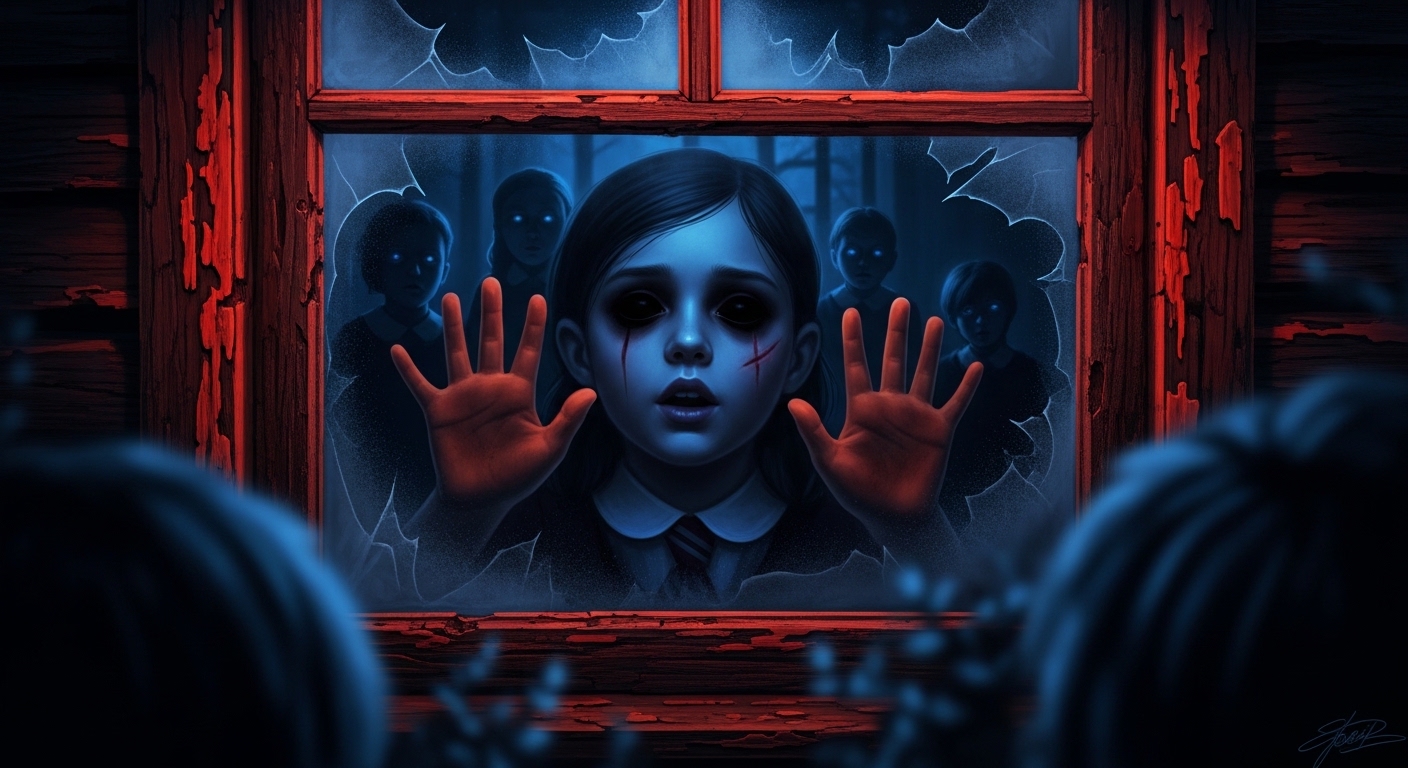
But I found old camp photos online. Every group photo taken near Cabin 13, if you look closely at the windows, you can see faces pressed against the glass from inside. Small faces. Watching.
To this day, I still check my apartment windows every night before bed. I tell myself I’m being ridiculous. But sometimes, just sometimes, I hear children singing those old camp songs in Hindi, and I remember Priya’s black eyes telling me about going home.
I never went back to find out what home meant for them.
I’m too afraid to know.