
I’ve been a locksmith for eleven years. Started the apprenticeship at nineteen, basically right out of school, working with my uncle’s firm out of Coventry. You see all sorts in this job — people locked out in their dressing gowns at two in the morning, crying over lost keys, embarrassed and cold. It’s honest work. Quiet work, mostly.
I never thought it would scare me.
The call came in on a Tuesday in February. I remember that specifically because I’d just finished a flask of tea and was thinking about heading home early. Slow afternoon. My colleague Dave had taken the van to Birmingham for a commercial job, so it was just me and the company car.
The address was a terraced house in Radford. The caller, a woman named Mrs. Albright from the council, explained that a property had been flagged during a welfare check. The previous tenant — an elderly man named Gerald Holt — had apparently died eighteen months ago, but the property had never been cleared. No next of kin. She needed someone to open the front door so the housing officers could assess the place.
Simple job. I mean, obviously I’d done hundreds like it.
Looking back, I should have paid more attention to how quiet she went on the phone when I asked how long the property had been sealed.
“Thirty years,” she said, eventually. “Give or take.”
I thought she meant the lock hadn’t been serviced in thirty years. I didn’t think to ask anything else.
The house was at the end of a terrace on a narrow street. It was the kind of February afternoon where the sky just gives up — grey and flat, the light already going by half three. Two housing officers were waiting on the pavement, a young lad named Connor and an older woman whose name I never caught. She had her clipboard pressed against her chest like a shield.
Something wasn’t right from the moment I looked at the door.
I couldn’t immediately say what it was. The paintwork was old, obviously. Peeling black gloss, the letterbox rusted shut, a faint brown tideline across the brickwork from decades of rain. Normal enough for an abandoned property. But the door itself — there was no draught excluder along the bottom. No gap at all, actually. It sat flush against the frame in a way that felt deliberate. Sealed, almost.
I crouched down to examine the lock. Yale deadbolt, original fitment, probably 1970s. Then I noticed the keyhole had been packed. Stuffed with something dark and waxy. I pulled a thin strip of it free with my pick. Candle wax, I thought. Old and discoloured and packed in deliberately, from the outside.
“Has anyone been in since Mr. Holt died?” I asked.
“That’s what we’re here to establish,” the woman with the clipboard said.
I let that sit for a second and didn’t push it.
The lock itself took about four minutes. Honestly it was straightforward enough once I cleared the wax. I felt the mechanism give, heard the familiar clunk of the bolt drawing back.
Then the smell hit us.
It wasn’t the smell of death — I’d encountered that once before on a welfare call in Stoke, and you never forget it. This was different. Older. Damp and sweet and chemical at the same time, like the inside of a very old wardrobe soaked in something floral. Connor actually stepped back off the step.
I pushed the door open.
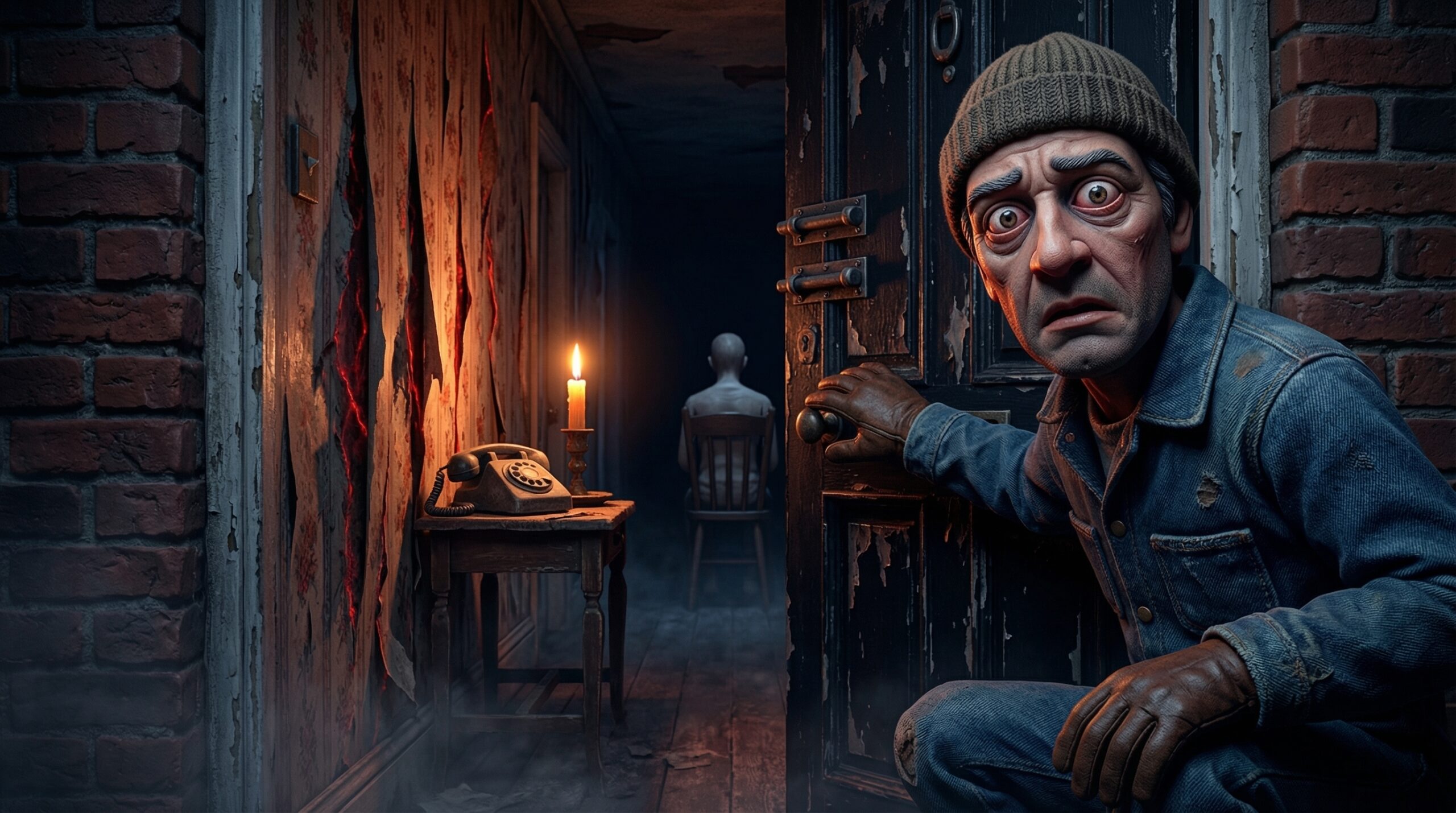
The hallway was dark. Curtains drawn throughout, what little light came in showed a narrow corridor, wallpaper peeling in long tongues from the walls, a telephone table with a rotary phone still sitting on it. Everything coated in a uniform grey dust, like the whole interior had been preserved in ash.
And then I noticed the locks.
There were three of them on the inside of the front door. A chain bolt. A barrel bolt at the top. And at the bottom, a heavy sliding bolt, the kind you’d fit on a garden gate. All of them engaged.
I felt my heart sink.
The door had been locked from both sides.
“That’s not possible,” Connor said, and his voice had gone very flat.
I didn’t say anything. I was staring at the barrel bolt, which was still in the locked position — meaning someone had slid it closed from inside this hallway, in this sealed house, that had been shut for thirty years.
Maybe I was just paranoid. Maybe the bolts had been in the locked position when the door was originally sealed. Except bolt mechanisms don’t engage themselves.
The housing officer with the clipboard had her phone out. She was calling someone. I stood there in the doorway — I didn’t go in, I want to be clear about that — and looked down the hallway.
There was a door at the end. Kitchen, I assumed. It was ajar.
I’ll never forget what I saw through that gap.
A chair. Facing the wall. And on the wall, at roughly seated head-height, a circular patch worn into the wallpaper. Smooth and dark, the way wallpaper gets when something rests against it repeatedly for years.
The chair wasn’t dusty.
We didn’t go inside. The housing officer ended her call and said very quietly that we should wait outside and she’d get the police involved. Nobody argued. Connor was already back on the pavement, smoking.
I locked the door again. I know that sounds strange. I mean, obviously there wasn’t much point by that stage — but it felt necessary. Like replacing a stone over something that should stay buried.
The police came. Then more police. I gave a statement, answered questions, drove home.
I’ve never gone back to that street.
To this day, I still check the bolts on my own door every night before bed. Top, middle, bottom. I do it without thinking now, more or less. My wife noticed after about a week and asked me why. I told her it was a habit from the job.
I didn’t tell her what the police detective said when she rang me three days later. That the room at the end of the hall had been locked from the inside too. That there was no other exit. That Gerald Holt had been dead for eighteen months, but certain things in that kitchen suggested someone had been eating there much more recently than that.
She said they were still looking into it.
That was two years ago.
I still think about the chair. About whatever wore that smooth dark circle into the wallpaper, sitting there in the dark for thirty years, waiting for someone to finally open the door.
I think about whether it was waiting to be let out.
Or whether, maybe, it had been locked in for a reason.