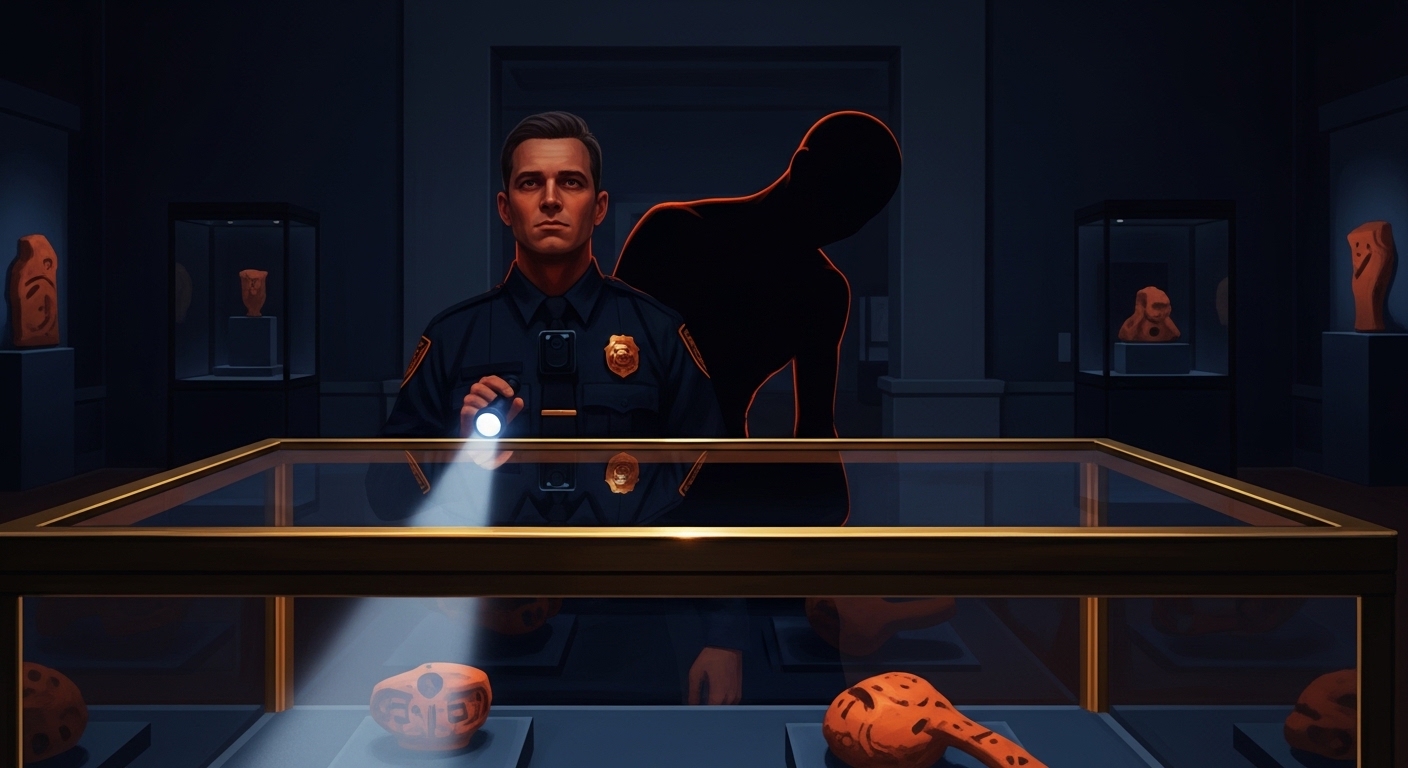
I’ve been working security at the British Museum for three years now. I’m twenty-four, and honestly, it’s a pretty cushy job most nights—just me, my torch, and a thousand years of history. The pay’s decent, the hours are quiet, and I get to walk through one of the most famous buildings in London without crowds of tourists shoving past me. Perfect, right?
I mean, that’s what I thought.
It started about two months ago. Small things, you know? I’d walk past the Egyptian gallery during my midnight rounds, and I’d swear the sarcophagus lid was at a slightly different angle than before. Or I’d pass through the Greek wing and feel like the marble statues were facing a different direction. Looking back, I should have paid more attention to those little changes. But you tell yourself you’re tired, that you’re seeing things. Obviously, objects in a museum don’t move.
Except they do.
The first time I really noticed something was wrong, I was in the Renaissance wing. There’s this painting—The Lady in Blue, we call it—of a woman standing in a garden, facing away from the viewer. Beautiful piece from 1643. I’d seen it hundreds of times. But that night, about an hour into my shift, I walked past it and stopped dead.
The woman was facing forward now.
I felt my heart sink into my stomach. I stood there for maybe five minutes, just staring, telling myself I was remembering it wrong. Maybe she’d always been facing forward. Maybe I’d confused it with another painting. But I hadn’t. I knew I hadn’t.
“Just tired,” I muttered to myself. “Been pulling too many doubles.”
I should have trusted my instincts.
The next week, things escalated. I started hearing it during my rounds—this low humming sound, almost like someone was playing a note on a pipe organ, but softer. It seemed to come from the Ancient Britain exhibit, where they keep the Bronze Age artifacts and Celtic treasures. I’d stand in the doorway, listening, and the sound would pulse. Rhythmic. Almost like breathing.
The torcs and ceremonial axes would be warm when I checked them, even though the room was kept at a constant fifteen degrees. I mean, I’d touch the glass display cases, and I could feel heat radiating through them. I reported it to my supervisor, obviously, thinking maybe there was an electrical issue. But the maintenance crew found nothing wrong.
“Maybe you’re just paranoid,” Marcus, the other night guard, told me. “Old building, mate. It creaks. It settles.”
I didn’t want to seem crazy, so I dropped it.
Then came the footage.
We wear body cameras during our shifts—museum policy after that theft attempt last year. I always check my footage the next morning, just to make sure everything recorded properly. It was a Tuesday morning, I’ll never forget, when I reviewed Monday night’s patrol.
The video showed me walking through the medieval gallery, my torch beam cutting through the darkness. Normal enough. But then, in the reflection of a glass case, I saw it.
Someone was walking behind me.
I felt my heart pound so hard I thought I was having a panic attack. I rewound the footage, watched it again. There, clear as day, was a figure. Tall. Walking in perfect sync with my steps. But I’d been alone. I knew I’d been alone. The museum had been locked down, alarms set, no one else on duty in that wing.
I watched the entire two-hour footage. The figure appeared in reflections, in the polished surfaces of display cases, in the glass of framed paintings. Always behind me. Always just out of direct view.
To this day, I still get chills thinking about what I saw next.
In one section of the video, I’d stopped to adjust my radio. I was standing still, facing a suit of Tudor-era armor. In the reflection of the breastplate, the figure behind me was clearly visible. And it was getting closer. Leaning forward, like it was trying to see what I was looking at.
I never saw it with my own eyes. Not once that entire night.
I went to my supervisor immediately. Showed him the footage. He watched it three times, his face getting paler each time.
“Don’t come in tonight,” he said. “I’m calling this up the chain.”
But I had to know. I mean, something wasn’t right, and I needed answers. So that night, against orders, I used my key card and went back.
The museum was dead silent. Even the usual ambient noise—the HVAC system, the building settling—seemed muted. I started my patrol in the Egyptian gallery, camera rolling, torch in hand.
That’s when I heard footsteps behind me.
I spun around. Nothing. The gallery stretched empty behind me, hieroglyphics glowing faintly in my torch light.
The footsteps continued. Matching my pace. When I stopped, they stopped. When I moved, they moved.
“Hello?” My voice cracked. “This isn’t funny. If someone’s here—”
The humming started. That same low, resonant sound from the Ancient Britain wing, but louder now. It came from everywhere at once, and I felt it in my chest, vibrating through my ribs.
I ran. I don’t care if that makes me sound like a coward—I ran. Through the Greek galleries, past the Enlightenment wing, heading for the staff exit. Behind me, the footsteps grew faster, heavier. Not running, but walking with impossible speed.
I burst through the exit door and didn’t stop until I was three blocks away, bent over on a street corner, gasping for air.
I quit the next day. Handed in my notice, didn’t even ask for a reference. My supervisor didn’t try to talk me out of it. He just looked at me with these tired, knowing eyes and said, “I don’t blame you, mate.”
Marcus, the guard who’d called me paranoid? He saw the footage from my final night. He quit too, two weeks later. Wouldn’t tell anyone why, but I heard from another guard that he’d started his own patrol and heard his name whispered in the darkness. Over and over. Right next to his ear.
The museum’s had trouble keeping night security ever since. I work at a Tesco now, stocking shelves on the late shift. It’s boring. It’s mundane. But I’ll never forget that feeling—knowing something was walking behind me, watching me, close enough to touch. And I couldn’t see it. Not until I looked at the reflection of what should have been there.
Sometimes, late at night when I’m walking home, I catch myself checking reflections in shop windows. Making sure I’m still alone. Making sure nothing’s following me.
Because honestly? I’m not entirely sure it stayed at the museum.