
I’ve been driving a tow truck along the M6 for nearly twelve years now, and I thought I’d seen everything. Blown tires, overheated engines, the occasional drunk who’d driven into a ditch—basically, nothing surprised me anymore. At least, that’s what I believed until last month.
The first call came in around half-past ten on a Tuesday night. Dispatch crackled through my radio: “Got a breakdown at mile marker 214. Woman says her car’s completely dead. Can you take it?”
“Yeah, on my way,” I said.
Mile marker 214 sits on a particularly desolate stretch between Lancaster and Kendal. There’s nothing out there except moorland and the occasional sheep. No services, no houses, just darkness and wind. I mean, it’s the kind of place where you wouldn’t want to break down, you know?
When I arrived twenty minutes later, there was no car. No woman. Nothing.
I radioed dispatch. “You sure about this location?”
“That’s what she said. Mile marker 214.”
I waited fifteen minutes, scanning the road in both directions. Maybe she’d gotten picked up by a mate or something. These things happen. I drove back to base thinking nothing more of it.
The second call came three days later. Same time of night, same location, same story—woman, broken-down car, mile marker 214. And again, when I got there, absolutely nothing. No tyre marks, no debris, no sign anyone had been there at all.
“This is getting weird,” I told dispatch when I called it in.
“Maybe someone’s having you on,” the dispatcher suggested.
I should have known then. I should have paid attention to the feeling in my gut—that cold, uncomfortable sensation that something wasn’t right. But I just drove back, annoyed that someone was wasting my time.
The third time was a week later. Same details, same location. By now, I was properly irritated. I decided I’d wait there for a full hour, see if anyone showed up. I parked my truck with the lights on, positioned so I could see the road clearly in both directions.
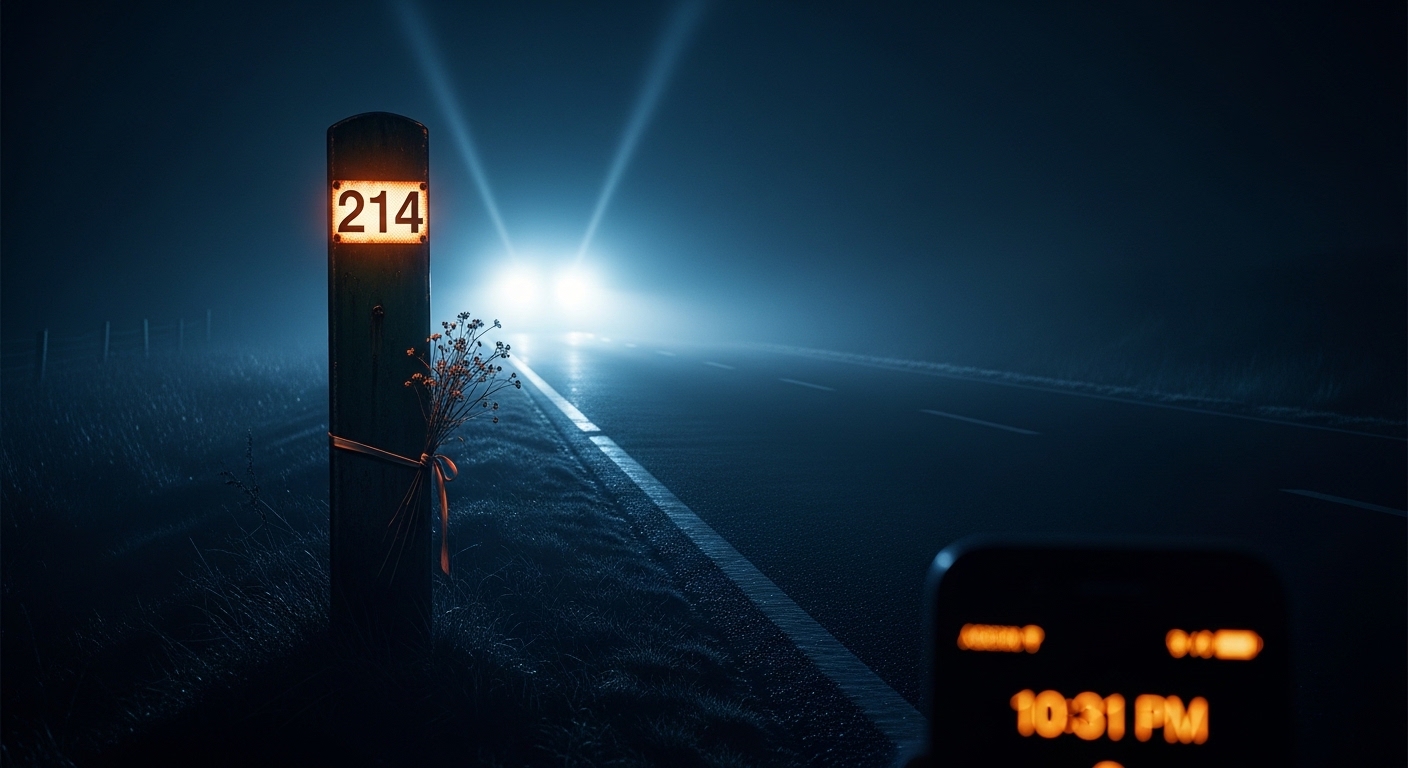
The wind picked up around midnight. Out there on the moors, it makes this howling sound that gets into your bones. I sat in my cab, drinking lukewarm coffee from my thermos, watching the mile marker sign sway in the wind. The number 214 seemed to glow in my headlights, almost like it was pulsing. Obviously, that was just my imagination, but still—I felt my heart start to pound a bit faster.
That’s when I heard it. A woman’s voice, faint and desperate, calling out, “Please! Is someone there?”
I grabbed my torch and jumped out. “Hello? Where are you?”
Nothing. Just wind and darkness. The voice had seemed so close, like it was right beside my truck. I circled the vehicle twice, shining my light across the moorland. Looking back, I realize how vulnerable I felt out there, alone in the middle of nowhere, searching for a voice that might not have been real.
I got back in my truck and locked the doors. My hands were shaking.
The fourth call came exactly one week later. I nearly refused it, but dispatch reminded me it was my job. “Just check it out, mate. If there’s nothing there again, we’ll report it to the police.”
Same routine. I arrived, found nothing, but this time I noticed something I’d missed before—a small bunch of wilted flowers tied to the mile marker post. They looked old, weathered. I didn’t touch them. Something told me not to.
The fifth call came last Tuesday. I was dreading it, honestly. But when I arrived at mile marker 214, there was actually someone there—a police car with its lights flashing. A young officer stood beside it, writing something in his notebook.
“You the tow truck?” he called out.
“Yeah. Did you call this in?” I asked, confused.
“No. I’m here following up on your reports. Dispatch contacted us about the repeated calls.” He paused, studying my face. “You look pale, mate. You alright?”
“I’m fine. Just… this has been going on for weeks now. It’s doing my head in.”
The officer nodded slowly. “I looked into this location. Mile marker 214. You know what happened here?”
I shook my head.
“August 1987. A woman named Sarah Mitchell broke down right here. She called for help—this was before mobiles, so she used an emergency phone. But it was a busy night, storms all across the region. By the time anyone got here, she’d died of hypothermia. Just sat in her car and froze to death.” He looked at the mile marker. “Those flowers have been here for decades. Her sister replaces them every year.”
I felt my heart drop into my stomach. “That’s awful, but what does that have to do with—”
“The investigating officers noted something strange in the report,” he interrupted. “After she died, her family kept receiving calls from her mobile—except she didn’t have a mobile in 1987. The calls started appearing on phone records years later, always to tow companies, always reporting a breakdown at this exact spot.”
My mouth went dry. “That’s impossible.”
“Yeah. I thought so too.” He pulled out his own phone and showed me something. “But dispatch sent over the call logs from your company. All five calls to you came from the same number. I ran it through our system. Want to know what I found?”
I didn’t want to know. I really, genuinely didn’t want to know. But I nodded anyway.
“The number was disconnected in 1994. Before that, it was registered to Sarah Mitchell.”
I drove straight home after that. Didn’t even finish my shift. When I got there, I pulled out my mobile and scrolled through my recent calls, even though I knew—I knew—what I’d find.
Five calls. All from the same number. All timestamped at exactly 10:31 PM.
I’ve requested a route change at work. My supervisor thinks I’m being paranoid, maybe having some kind of breakdown. I don’t care. I’ll never drive past mile marker 214 again if I can help it.
But here’s the thing that keeps me awake at night: three days ago, my phone rang at 10:31 PM. I didn’t answer it. I couldn’t. The caller ID showed that disconnected number again.
She’s still calling. Still waiting. Still hoping someone will come.
And I don’t know how to make it stop.