I was nineteen when I started working the evening shift at Bombay Bytes — that’s what we called it, though the actual name on the signboard was Sub Station, one of those sandwich chains that had been spreading across Mumbai like moss on a monsoon wall. The franchise was in Andheri West, tucked between a closed pharmacy and a STD booth that nobody used anymore. I needed money for college fees, my mother needed the help, and basically the job seemed simple enough. Make sandwiches. Smile. Go home.
I mean, I wasn’t expecting it to be the best job in the world. I was expecting boring. I was expecting fine.
Looking back, I realize I should have paid more attention to the fact that nobody lasted long there. Three employees had quit in the month before I joined. My manager, Vikram sir, told me people just “moved on.” I believed him. I was nineteen and stupid and needed the money.
The first thing I noticed about the night manager was that he didn’t say much.
His name was Fernandes. No first name, just Fernandes — that’s what Vikram sir called him, that’s what everyone called him. He came in at nine every night, right when the dinner rush was dying, checked the stock room, walked the floor once, and then sort of… settled into the back office. You’d see the light under the door. You’d hear nothing.
He was pale in a way that didn’t make sense for Mumbai, you know? Like he’d been kept somewhere dark for a long time.
But whatever. Pale people exist. I wasn’t going to make a whole thing out of it.
The real strangeness started with the regular.
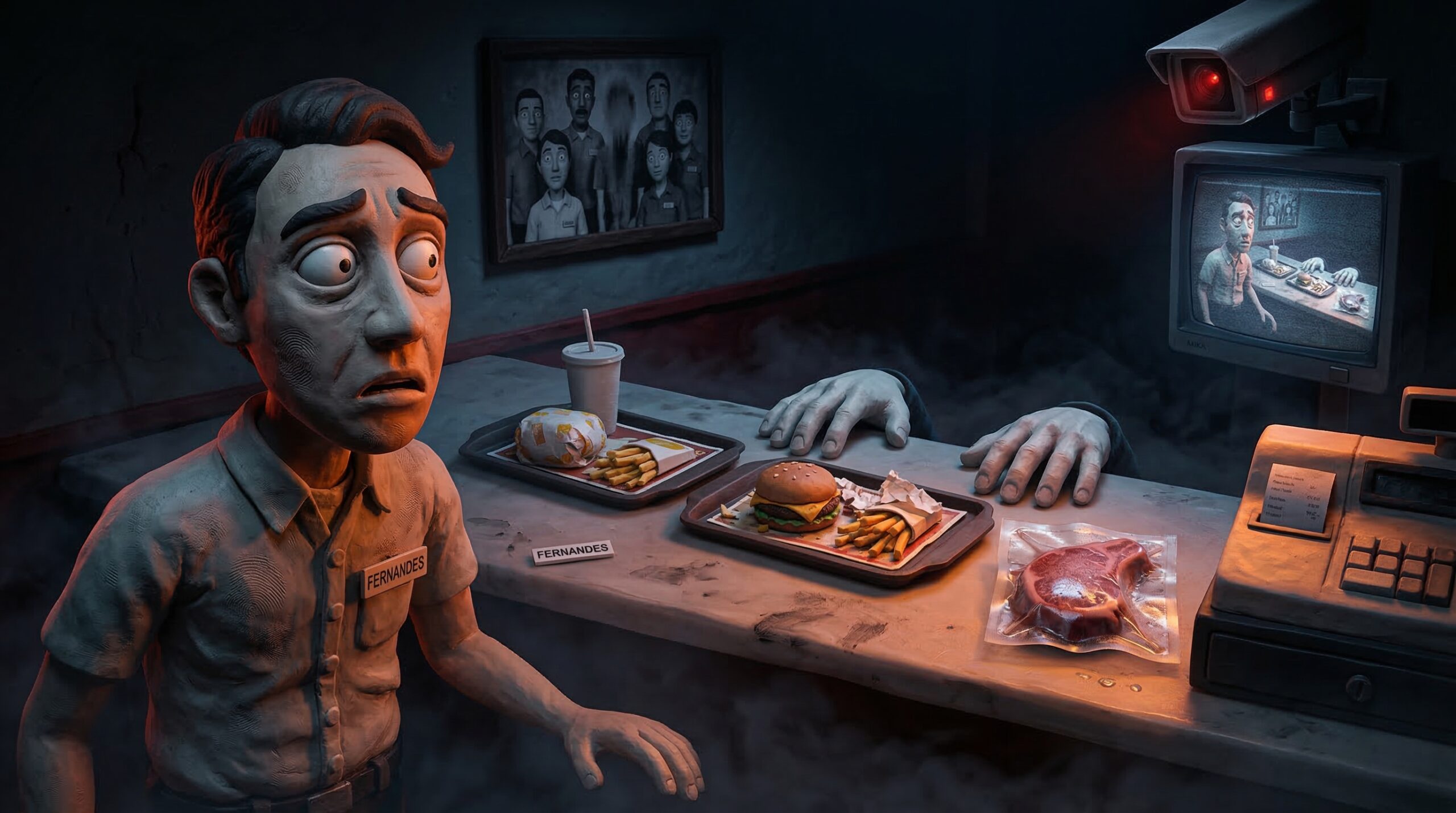
He came in every Thursday around ten-thirty. Heavyset man, maybe fifty, always in a white kurta that had this faint yellowish stain near the collar I tried not to look at. He’d walk up to the counter and order two footlongs — chicken tikka and something called a “special” that wasn’t on any menu I’d been trained on. When I asked about it the first time, my senior Priya just shook her head slightly and said, “Make him the chicken tikka, give him extra napkins, and don’t look at who he’s pointing to.”
“Pointing to?” I said.
“Just do it,” she whispered.
So I did. And yes — he was gesturing beside him. Talking to the empty space next to him. Saying things like, “No, you’ll like this one,” and “Don’t worry, I told you I’d handle it.” He’d pull out his wallet and pay for two meals, take both trays, set one across from himself in the corner booth, and eat in silence facing the wall.
Maybe I was just paranoid. I told myself he had a Bluetooth earphone I couldn’t see. I told myself Mumbai is full of eccentric uncles.
Then, about three weeks in, the meat delivery came in wrong.
It was a Tuesday. I was alone in the back, Priya had stepped out for chai, and the delivery boy handed me the cold box and left faster than usual. I started stacking the packets and one of them was — I don’t know how to explain it. The weight was wrong. The shape inside the vacuum seal was wrong. It wasn’t the flat, uniform slab of processed chicken we always got. It was curved. Jointed.
I felt my heart drop.
I put the packet aside and didn’t touch it again. When Priya came back I told her. She looked at it for exactly two seconds, walked it to the bin outside, buried it under other garbage, and said, “Never open the wrong ones.”
“The wrong ones?” I said. “What does that mean? How often does this—”
“Rohan.” She looked at me the way you look at a child who is about to touch something hot. “Just never open them.”
I should have quit then. I know that now.
The photograph thing was what broke me.
One of the other guys, Deepak, had this tradition of taking a group selfie every time someone completed three months at the store. Little celebration. Vikram sir always joined in because he was that kind of manager — genuinely nice, always smiled for photos.
Fernandes never joined, obviously. He was always in the back office during selfie time. We’d assumed it was just his personality.
But one night — close to midnight, it was — I was scrolling through Deepak’s photo folder on his phone while he showed me something funny, and I stopped scrolling. I went back. And forward. And back again.
Every photo. Vikram sir in every single one. The other staff in every one. Sometimes customers in the background, random strangers.
Fernandes was in some of those background shots. He must have walked through the frame without realizing.
Except he wasn’t there. I mean, his outline wasn’t there. Everyone else was crisp. Where Fernandes walked, there was just — a blur. A smear. Like the camera had decided something in that space wasn’t allowed to be seen.
I heard a door open behind me.
I did not turn around for a long moment. I was standing at the counter, holding Deepak’s phone, and I could hear footsteps coming from the back office — slow, unhurried, the way something walks when it knows you have nowhere to go.
Something wasn’t right. Every part of my body knew it before my brain did. My hands went cold. My mouth dried out.
I turned.
Fernandes was standing at the end of the counter, watching me. He wasn’t doing anything threatening. He was just watching, with this expression that wasn’t quite a smile but had all the same geometry. His eyes were open a little wider than eyes should be.
“Long shift,” he said. Just that.
I said, “Yeah.”
He nodded. Went back to the office. The light came on under the door.
I clocked out forty minutes early. I told Vikram sir I felt sick, which was the truest thing I’d said all month.
I never went back. I WhatsApp’d my resignation at 2 AM and blocked the number when Vikram sir tried to call.
I still live in Andheri, I mean I couldn’t exactly move, my family is here. But I don’t walk past that stretch of road at night. And sometimes on Thursdays, if I’m near that area, I think about the regular in the white kurta — who he was talking to in that empty seat, what he ordered for them, and whether they could actually eat it.
To this day, I still don’t open any vacuum-sealed packet that feels wrong in my hands.
I’ll never forget the way Fernandes said long shift — like he’d been counting the minutes along with me. Like he’d been waiting to see how long it would take before I understood.
Looking back, I realize he wasn’t threatening me.
He was just letting me know that he knew that I knew.
And that was enough.